
The agency will have 51 firefighting aircraft working this year.
Continue reading
The agency will have 51 firefighting aircraft working this year.
Continue reading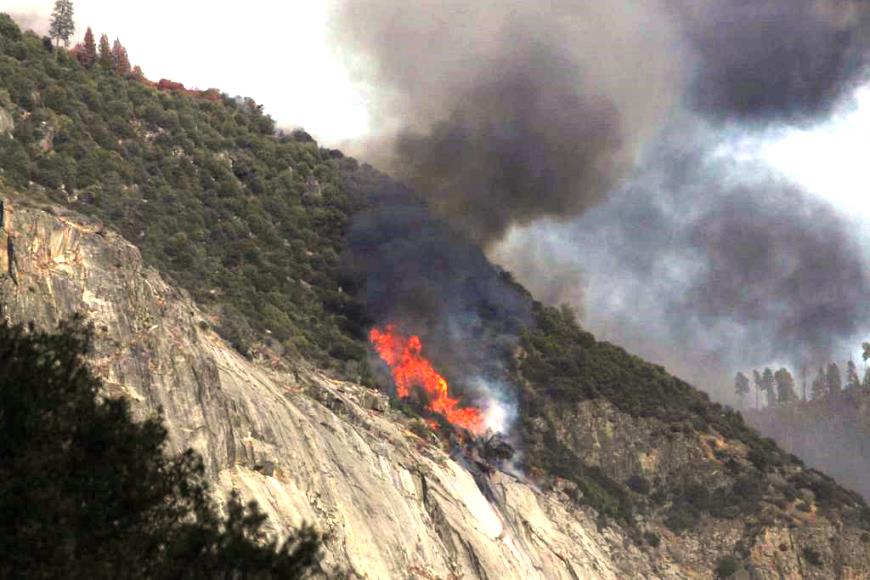
In a preliminary report that was released Tuesday night, the National Transportation Safety Board said the S-2T air tanker that crashed near Yosemite National Park in California on October 7 may have struck a tree which broke off a part of the aircraft’s wing.
Two other firefighting aircraft were in the area at the time. A lead plane preceded the air tanker into the drop area but that pilot did not see the crash. However the crew of an air attack ship overhead did, and they told the NTSB that the S-2T may have struck a tree, causing part of a wing to break off.
Both aircrews reported that there was smoke in the area, but visibility was good.
The air tanker was stationed at the air tanker base at Hollister, California, and had been dispatched to the Dog Rock fire. The airplane arrived on scene, made one drop on the fire, then proceeded to the Columbia Airport to be reloaded with fire retardant before it returned and made its final flight. Pilot Geoffrey “Craig” Hunt died in the accident.
A resident in the area of the crash site told us that locals took quite a few photos and a video that will help the NTSB’s investigation. They are unwilling to release the imagery to the public until after the investigation is complete.
It will be many more months before the NTSB releases their final report.
CAL FIRE Director Ken Pimlott issued the following statement regarding the NTSB’s preliminary information on the crash.
“Aerial firefighting is not simply flying from one airport to another. The wildland firefighting environment is a challenging one, both on the ground and in the air,” said Chief Ken Pimlott, director of CAL FIRE. “We look forward to the final NTSB report to see if we can use the findings to help mitigate the inherent dangers of the job. We owe that to Craig, who traded his life in an effort to protect the lives of others.”

The Federal Aviation Administration’s web site lists the preliminary cause of the crash of Tanker 81, an S-2T, as a “wing striking a tree”. That is consistent with information we have from witnesses of the accident.
The Fresno Bee reported that Keith Halloway, a spokesman for NTSB which is the lead investigating agency, said Wednesday evening that the board may have a preliminary report next week, but determining a probable cause for the crash could take 12 to 18 months.
The pilot of the S-2T that died in the air tanker crash on October 7 was Geoffrey “Craig” Hunt, age 62, of San Jose. He was a 13-year veteran pilot with DynCorp International which has the contract to maintain and operate the 23 S-2T air tankers for CAL FIRE. Mr. Hunt was attempting to drop retardant on the Dog Rock Fire near Yosemite National Park in California when the accident occurred.
More information:


The pilot of the S-2T that died in the air tanker crash on October 7 has been identified as Geoffrey “Craig” Hunt, age 62, of San Jose. He was a 13 year veteran pilot with DynCorp International. DynCorp has the contract to maintain and operate the 23 S-2T air tankers for CAL FIRE. Mr. Hunt was attempting to drop retardant on the Dog Rock Fire near Yosemite National Park in California when the accident occurred.

“We continue to mourn the tragic loss of Craig,” said Chief Ken Pimlott, CAL FIRE director. “We know wildland firefighting is an inherently dangerous job, but Craig made the ultimate sacrifice.”
“Our thoughts and prayers are with Craig’s family during this difficult time,” said Jeff Cavarra, program director for DynCorp.
Mr. Hunt’s body was watched over Tuesday night by fire and rescue personnel and was recovered Wednesday morning. A National Park Service honor guard then transferred Mr. Hunt to CAL FIRE personnel.
Immediately after the crash, CAL FIRE grounded their remaining air tankers, which is standard procedure after a serious accident.
A graphic photo of the flaming wreckage falling down the steep slope has been posted at a rock climbing forum.
The S-2T air tanker, registration number N449DF, was designated Tanker 81, one of 23 S-2Ts that are maintained and flown by DynCorp for CAL FIRE. The agency also has one spare that is used to fill in as needed when an aircraft is undergoing maintenance. CAL FIRE hires their own pilots for their 11 UH-1H Super Huey helicopters, but they are also maintained by DynCorp.
The last time a CAL FIRE air tanker crashed was in 2001, when two tankers collided while fighting a fire in Mendocino County, killing both pilots, Daniel Berlant, spokesperson for CAL FIRE said.
The agency had another plane crash in 2006, when a battalion chief and a pilot were killed in the crash of an air attack plane in Tulare County.
The S-2 first flew in 1952 and the U.S. Navy discontinued the use of them in 1976. They were used for detecting enemy ships and submarines and for dropping torpedoes. The ones currently being used by CAL FIRE were converted from piston to turbine engines between 1999 and 2005. Some media outlets are incorrectly reporting that the Tanker that crashed on Tuesday was built in 2001. That may be the date that it was converted to turbine engines and was given the new model name S-2F3 Turbo Tracker. They are now commonly referred to as S-2T, with the “T” standing for turbine engine.
More information about the crash and the Dog Rock Fire is at Wildfire Today.
Our sincere condolences go out to the family, friends, and coworkers of Mr. Hunt.
CAL FIRE has announced that an S-2T air tanker has crashed while fighting the Dog Rock Fire in Yosemite National Park in California. There is no word yet about the condition of the pilot. Emergency personnel are hiking to the crash site.
More information is at Wildfire Today.
Thi above video shot at the Courtney Fire three miles southeast of Oakhurst, California shows slow motion drops from a DC-10, P2V, S-2, and a couple of other aircraft that are too far away to determine the model. And, check out what appears to be an explosion at 0:29.
We spent some time yesterday at the Redding Air Attack Base in California and shot photos of the aircraft and will be posting them over the next few days. Here are a few to get started. Click on the photos to see slightly larger versions.
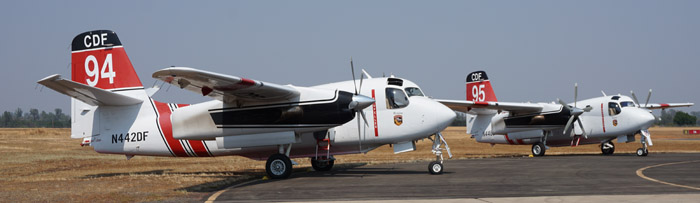


All of the photos were taken by Bill Gabbert and are protected by copyright.

We are honored to present a photographic essay of air tankers by professional photographer Joe Cupido. He tells us below about his career in photography.
I grew up in a military family and acquired the love of aviation early on. When I was in high school I started photographing aircraft. Then later while in the military I became a Combat Photographer / Photojournalist and continued photographing aircraft professionally. I specialized in Air to Air photography working with the military and for some of the major aircraft companies. I was lucky enough to finish my career with about 5,500 hours in over 100 different airframes, 7 books and over 2,000 magazines articles on aviation subjects.
I’ve always enjoyed chasing fire-fighting aircraft whenever I had the time. The images below were captured over time and with a lot of cooperation from a lot of good people in the Air Tanker business. Without their help I could not have captured the images that I did and I thank all of you. Hope you enjoy!
Thanks Joe!


We took these photos last week, March 20, at the Aerial Firefighting conference in Sacramento. There were about 90 minutes set aside for displays of firefighting aircraft at McClellan Air Force base, as well as live demonstrations of water and water pellet drops from a helicopter, and the use of the AirTEP Airborne Tactical Extraction Platform marketed by Aerial Machine Tool. We have photos of Coulson’s C-130Q in another article.


We had an opportunity to photograph some of the aircraft at McClellan Air Force base today. Click on the photos to see larger versions.


