Firefighting resources have been prepositioned in southern California for the last two days in order to be ready for any wildfires that break out during the predicted strong Santa Ana winds. There has been “light initial attack” fire activity over the last couple of days, according to the Southern California Geographic Area Coordination Center, but no large fires so far. Maybe this can be credited not only to the not-quite-as-strong-as-expected winds, but to aggressive initial attack by the fire agencies. One fire near Fontana burned a few hundred acres before firefighters put it out. Photos of that fire by tjvphoto can be found HERE.
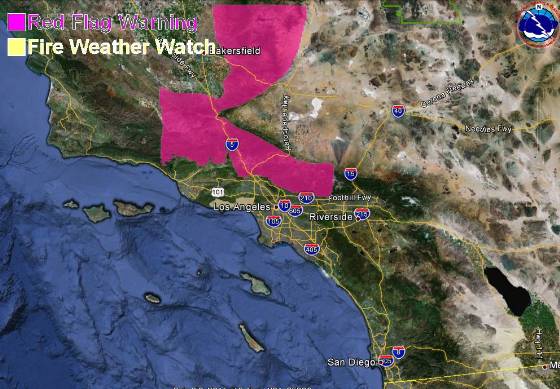
The Red Flag Warning is still in effect through Saturday evening. While the winds have been fairly strong, the predicted northeast winds of 20 to 30 mph gusting at 50 to 60 mph have not quite materialized in most areas. The effect of the Santa Ana condition has been quite variable in southern California, but the Chilao weather station on the Angeles National Forest has been recording some of the highest wind speeds. Since 12:53 a.m. on Saturday it has seen sustained winds in the 30s with gusts above 40 mph; the strongest gust was 49 mph.
Red Flag Warnings, 8:26 a.m. PT, October 27, 2012. These warning areas can change throughout the day as various NWS offices update their forecasts.
The forecast is for northeast winds of 25 to 30 mph gusting up to 30 on Saturday, but the relative humidities will be very low, in some areas going down to 5 percent during the afternoon. The winds will decrease in the late afternoon when the pressure gradient relaxes as the surface high over the Great Basin shifts.
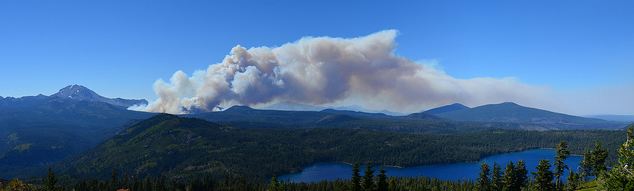
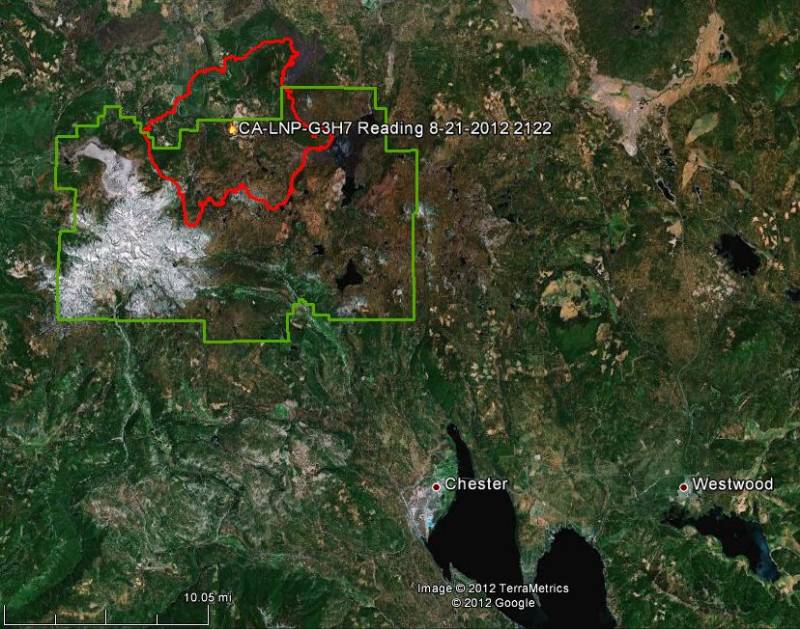
Two Congressmen held an informal hearing in Sacramento on Wednesday to hear concerns about the Reading Fire that started in Lassen Volcanic National Park in northern California. The fire was not aggressively suppressed, and later escaped the park and burned 11,071 acres of US Forest Service land and 75 acres of privately owned land outside the boundaries.
Final perimeter (in red) of the Reading Fire. The green line is the boundary of Lassen Volcanic National Park.
It started from lightning on July 23 and after about two weeks was only 95 acres while being managed for multiple objectives as a “fire for resource benefits”. Fire managers established a 700-acre box in which they intended to contain the fire by taking suppression action as needed to keep it from crossing the lines drawn on a map.
Size of the Reading Fire through August 12
They were unsuccessful, and on August 6 it moved out of the park, ultimately burning 28,079 acres by the time it was contained on August 21. By August 23 the National Park Service had spent $15,875,495 observing, managing, and later suppressing the fire.
Some of the local residents said at the hearing that with the decline of the timber industry they now rely heavily on tourism. According to their testimony the fire had a negative impact on some of the local businesses during a critical time of the year for their revenue.
The list of government officials that testified at the hearing included:
U.S. representatives Wally Herger, R-Chico, and Tom McClintock, R-Granite Bay
Bill Kaage, the park service’s chief of the Branch of Wildland Fire
Andy McMurry, CAL FIRE’s statewide deputy director
Joseph Millar, director of Fire and Aviation Management for the US Forest Service’s Pacific Southwest Region
Rick Kyle, Shasta County Fire Warden
Steve Fitch, retired Forest Supervisor of the Shasta-Trinity National Forest
According to the Associated Press, Rep. Herger said:
The officials responsible for allowing the fire to burn during “a terrible fire season” should be removed and changes made to the national policy that uses managed wildfires as a tool to clear out forests and improve wildlife habitat.
Mr. Millar said in the hearing that the US Forest Service required all of their fires be aggressively suppressed last summer due to the severity of the fire season. However, the real reason may have been that the agency ran out of enough money to manage limited suppression fires for weeks or months.
CAL FIRE’s Andy McMurry testified that if the fire had started on state-protected lands they would have attempted to put it out immediately.
Retired Forest Supervisor Steve Fitch had earlier blasted the National Park Service for not aggressively suppressing the fire, saying:
I can’t believe they went ahead with letting a fire burn for the ecosystem’s benefit in a season that, for the entire nation, is record dry.
Of course with the benefit of hindsight, a person could assume that if the NPS had suppressed the fire when it was 1/4 acre, or two weeks later when it was 95 acres, it would not have spread outside the park and cost the taxpayers $25 million dollars, and would not have impacted the revenue the local businesses depend on in the summer.
The National Park Service has a mixed record when it comes to accepting accountability for serious mistakes. The Superintendent of Mount Rushmore National Memorial absolutely refused to do so in 2009 when protesters easily cruised through inadequate security measures to hang a huge banner over the sculpture. Superintendent Gerard Baker said:
Is it too bad it happened? Yes. Do I think it was my responsibility? Absolutely not. We did everything proper.
A few months later on the other hand, the acting Superintendent of Yosemite National Park Dave Uberuaga took full responsibility for the planned 90-acre prescribed fire that escaped and became the 7,425-acre Big Meadow fire:
I take full responsibility…I have apologized to the communities. I regret that we had to evacuate them. And I regret the situation we find ourselves in. Still, prescribed fire is a necessary tool in the park.
According to the Record-Searchlight, Lassen National Volcanic Park superintendent Darlene Koontz said in August that her agency apologizes for the “impacts” caused by the Reading fire.
NPS spokesperson Roberta D’Amico told Wildfire Today that the National Park Service has commissioned an interagency investigation which should be complete by mid-November. We will be anxious to see if the report concludes that the agency “did everything proper” in managing the Reading fire.
John N. Maclean had an opinion piece published on the New York Time’s web site October 18 in which he wrote about penalties that have been assessed against arsonists and others who have started wildfires. He also provided some thoughts about how to prevent fires through legislation, and wrote about fires started by shooters, exploding targets, and all-terrain vehicles. Mr. Maclean is the author of several books about wildland fires, including Fire on the Mountain, The Thirtymile Fire, and the forthcoming book The Esperanza Fire: Arson, Murder and the Agony of Engine 57, about a 2006 wildfire in California.
Waldo Fire volunteer faces sex assault charge
A man who was volunteering for the Red Cross during the Waldo Canyon fire in Colorado Springs earlier this year is facing charges of sexually assaulting another volunteer. The victim told police she believes 71-year old Allen Crabtree drugged her and then sexually assaulted her on July 7.
The video below is a simulation of the spread of the Esperanza fire which killed five U.S. Forest Service firefighters in 2006 near Cabazon, California. Raymond Lee Oyler was sentenced to death after he was convicted of five counts of murder and 37 counts of arson for starting this fire and many others.
The simulation was produced by Janice L. Coen of the National Center for Atmospheric Research and Philip J. Riggan of the Pacific Southwest Research Station.
It takes a supercomputer to run a mathematical simulation, or model, of the complex processes observed in wildfires. It often takes yet more computing power to visualize the data coming out of the computer model. This fire-behavior simulation reproduces the October 2006 Esperanza Fire near Cabazon, California. Using data from the NCAR fire-weather model, simulations like this one are helping scientists explain the physical processes and behavior within large wildfires.
An arsonist ignited the blaze on the upwind edge of Cabazon Peak during a Santa Ana wind event. Driven by gusty Santa Ana winds, dry chaparral fuels, and steep terrain, the fire rapidly spread up into the San Jacinto Wilderness.
The simulation reproduces several features observed during the fire: the rapid spread to the west-southwest, runs of flame up canyons that lay perpendicular to the wind direction, splitting of the fire into two heads, and feathering of the fire line at the leading edge.
—–Coupled Weather-Fire Simulation of the Esperanza Wildfire—–
Science: Janice Coen (NCAR) and Phillip Riggin (Pacific Southwest Research Station, USDA Forest Service)
Visualization: Janice Coen and Alan Norton, NCAR, using VAPOR (Visualization and Analysis Platform for Ocean, Atmosphere, and Solar Researchers) http://www.vapor.ucar.edu
More information:http://www.mmm.ucar.edu/people/coen/files/newpage_m.html
Lookout Fire, 11:21 a.m. PT, October 17, 2012, Credit KEYT
(Originally published at 11:50 a.m. PT, October 17, 2012; updated at 6:00 p.m. PT, October 17, 2012)
UPDATE: The fire is 45 percent contained and evacuations have been lifted. The estimated size is holding at 20 to 25 acres. No structures have been damaged. One firefighter suffered a minor leg injury.
===============
Firefighters are aggressively attacking a new vegetation fire, the Lookout fire, in the Los Padres National Forest six miles northwest of Santa Barbara, California. Approximately 40 structures have been evacuated and another 100 are threatened. The fire is in the 2500 block of Highway 154.
Tanker 41 drops on Lookout fire, 12:06 p.m. PT, October 17, 2012. A screen grab, credit KEYT
(A better photo of Tanker 41 dropping is at SFGATE.com.)
Early in the fire, which was reported around 8 a.m. PT, at least five and according to some reports as many as eight air tankers were ordered.
KEYT is live-streaming video of the fire.
Lookout Fire, S2T drop, 11:23 a.m. PT, October 17, 2012. Credit KEYT
Captain David Sadecki of the Santa Barbara County Fire Department said at 11:00 a.m. PT the fire had burned about 15 acres. It is burning on a steep slope in very heavy brush below homes. At 11:50 a.m. the size was estimated at 20 to 30 acres by a firefighter interviewed by KEYT. The spread of the fire has slowed, but there is still a lot of open line left in thick vegetation.
This is an example of how firefighters in some areas of California use overwhelming force to aggressively attack new fires. After having burned for about 3.5 hours, if they can keep it at 20-25 acres, it will be another success story.
Map of Lookout fire
The resources that were dispatched to the fire during the early stages included:
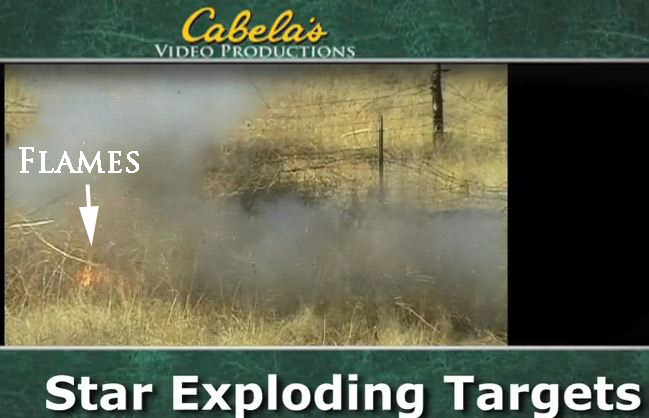
A screen grab from a video endorsed by Cabela’s demonstrating a Star Exploding Target. We added the arrow and the “Flames” text to point out that flames are visible following the explosion.
Originally published October 11, 2012, updated February 6, 2013
Targets that are designed to explode when shot with a rifle have become more popular in recent years, emerging as an increasing threat to our wildlands. The problem is, they sometimes start fires in spite of claims by the manufacturers saying they are safe.
The military has been using them for at least 20 years when training marksmen to hit targets hundreds of yards away, since it can be difficult to see if a target was hit at that distance. When struck with the bullet from a rifle, the explosion and smoke are easily seen and indicate that the shooter hit the target
They are sometimes called “binary exploding targets”, since they are completely inert until two powders are mixed at the site by the target shooter. After they are combined, the compound is illegal to transport. The manufacturers claim that the only way they can be detonated is by striking them with a high-velocity bullet fired from a high-powered center-fire rifle. At least one company has recently started offering targets that will explode when hit with a much less powerful .22 caliber rim-fire rifle.
While the manufacturers claim they can’t start a fire, the screen grab (above) from a video shows flames in the grass just after a target advertised by Cabela’s and manufactured by Star Exploding Targets, explodes. The video is below, however we expect that eventually Cabela’s and Star will remove it from YouTube. The flames are visible three seconds into the video at the bottom left.
In a quick search, we found numerous reports of wildfires having been caused by exploding targets in a 5-month period. The dates below indicate when the information was published.
June 17, 2012, Colorado. The Springer Fire in Park County on the Pike National Forest burned 1,045 acres. It was caused by exploding targets.
June 13, 2012, Idaho. Four wildfires were caused by shooters using exploding targets up to that date in 2012.
June 15, 2012, Washington. A small fire near the mouth of the Grande Ronde River was apparently started by someone shooting at exploding targets.
June 16, 2012, Utah. The 300-acre Little Cove fire was caused by shooters using exploding targets.
June 29, 2012, Utah. A fire investigator said eight wildfires in the previous three weeks were caused by shooters using exploding targets.
July 2, 2012, Nevada. A five-acre fire in Elko was caused by shooters using exploding targets.
August 19, 2012, Oregon. Five shooters were cited for starting a 35-acre fire using Tannerite exploding targets.
September 6, 2012, Washington. The Goat Fire burned 7,378 acres 3 miles southwest of Pateros, WA. It was started by exploding targets. Forest Service officials previously said two smaller fires — a 120-acre blaze in Mud Creek Entiat and one on Deadman Hill near Cashmere — may also have been ignited by exploding targets.
October 7, 2012, Pennsylvania. Two state Game Commission workers suffered injuries including burns, temporary blindness and hearing damage when an illegal exploding target blew up while the men attempted to put out a fire at a gun range in Pike County.
October 11, 2012, California. A 364-acre fire was started by shooters using exploding targets. A news report (see video below) shows two pounds of the explosive being used to blow up a car.
October 19, 2012, Utah. Two men have been charged with starting the Dump fire near Saratoga Springs, Utah that burned more than 5,500 acres and cost $2.1 million to put out. About 2,500 people were forced to evacuate. Investigators say the men were shooting June 21 when they hit an explosive target that started the fire in vegetation.
October 23, 2012, Nebraska. Three men have been charged with starting a fire by using exploding targets in Nebraska, and starting the Spotted Tail fire that burned 83 acres south of Chadron October 23.
This is a total of 24 fires that were either confirmed or suspected to be caused by exploding targets since the first of June, 2012. And these are just the ones that we were able to find using Google.
In most areas in the western United States exploding targets are illegal to use if there is a law or temporary ban on open fires.
One of the primary manufacturers of the targets is Tannerite. The company has a patent on the devices and has said the fires are caused by other companies infringing on their patent and adding an additional incendiary component in order to produce a more spectacular explosion.
At an online forum for firearms enthusiasts, The Firing Line, some of the posters decry the lack of wisdom of target shooters who start fires with exploding targets. A person using the moniker “g.willikers” wrote:
It seems that we gun owners have two enemies. Those who would deprive us of our gun rights. And those who throw those rights away.
Others on the forum suggested some alternative targets that can produce an impressive display when hit with a bullet, such as:
A milk jug filled with water
Potatoes
Pop can filled with water
Fresh cow pie
UPDATE October 12, 2012:
Ken told us about this news report that appeared on television in southern California October 11, 2012, explaining and demonstrating the hazards of these explosive targets. They use two pounds of the explosive to blow up a car, and Chief John Hawkins of CAL FIRE provides his point of view on the problem.
Air Spray Aviation Services, which operates Lockheed L-188 Electra “Longliner” air tankers and Turbo Commander 690 “Bird Dog” aircraft in Canada, has established a new United States headquarters at Chico, California. They announced yesterday that they have acquired a BAe-146 airliner which they will convert into an air tanker.
Currently Neptune Aviation operates two BAe-146 air tankers which were converted by the Prince Edward Island based Tronos Aviation. Minden Air Corporation has been working on converting a BAe-146 for at least a couple of years but their version has not yet dropped on a fire. Minden has a contract with the US Forest Service to supply two of them, one in 2012 and the second in 2013. Aero Flight has a contract to provide two Avro Rj85s in 2013, an aircraft that is a variant of the BAe-146.
The BAe-146 is considered a “next generation” air tanker by the US Forest Service. It is jet powered, can cruise at 498 mph, and the Tronos version has a maximum capacity of 3,000 gallons of retardant.
A Facilitated Learning Analysis for the entrapment of an engine crew tells the harrowing story of five firefighters who had a very close call on the Flat Fire on the Shasta-Trinity National Forest in northern California July 14, 2012. Their survival may have been due in part to the fire above them burning through the trunk line on their hose lay, causing a leak which sprayed water on the fire creating an opening for the crew to escape back to the engine. Until then, at least one of the crew members thought he was going to die.
The crew of Engine 1 was attempting to suppress a 1/4-acre slopover below a road by installing a progressive hose lay. Initially the fire behavior was minimal, with one-foot flame lengths. They had completed 300 feet of the hose lay when the main fire made a run up to their location.
The entire FLA can be found here, but below is an excerpt:
…The Engine 1 Engine Operator (ENOP) takes substantial heat from the fire run and takes shelter in the engine, then gets out and begins defensive engine protection with a 1.5 inch hose. This run hits the fireline and ignites additional spot fires east of the B spur to the south and east of the position of the Engine 1 crew and the original slopover. Flame lengths and rate of spread on these fires increase dramatically. The amounts of smoke and noise on the B spur increase also with the increased fire behavior making communication over short distances nearly impossible. The Engine 1 Engine Boss (ENGB) calls Division Supervisor (DIVS) Z (T) and states that they are abandoning the hoselay. This transmission is heard by Engine 2 and the engine Strike Team Leader and Strike Team Leader trainee (who are driving up French Creek Road towards DP-2). DIVS Z (T) responds saying that he had been trying to contact the ENGB to advise them to withdraw from their position because of increasing fire behavior, but was unable due to the high level of radio traffic. Radio traffic on Division Tac only pauses briefly and then resumes to being almost continuous.
The Engine 1 ENGB and the crew begin to rapidly withdraw back up the slope towards the engine as the fire closes around them. The ground is wet and slippery with foam from the initial suppression efforts and the slope is about 30 percent. The ENGB considers escaping downhill and rejects this option because it would mean leaving the ENOP in a hazardous position. As the crew moves uphill towards the engine, fire downhill of them continues to close, compromising a downhill escape route.
The ENOP considers cutting the hoselay and escaping in the engine and rejects this option because it would mean cutting off the water supply to the crew’s hoselay, leaving them without protection. The ENOP continues defensive engine protection.
The fire makes another run up from Pelletreau Creekand the fire to the east of the B spur closes to block the escape route of the Engine 1 crew while the crew is about 30 feet from the road, creating an entrapment.
Visiting the site after the incident, a member of the crew stated, “I thought that I was going to die, right here.” After a moment, the fire ahead of the entrapped crew burns through the trunk line on the hoselay spraying water on the fire and creating an opening for the crew to escape back to the engine.
As the crew reaches the B spur, there is a large pine torching next to Engine 1 and the front left tire is burning along with vegetation next to it, making their position at the engine untenable.
The ENGB transmits over Division Tac that the channel be cleared for emergency traffic, and then calls DIVS Z (T) on Division Tac requesting additional resources and states Engine 1 is on fire and that he is abandoning the engine. All five crewmembers from Engine 1 walk north up the B spur about 150 or 200 feet until they reach cooler air and less smoke. DIVS Z (T) calls the Engine 1 ENGB and confirms that the Engine 1 crew is accounted for and there are no injuries. Three crew members from Engine 1 then move west to the black and onto the dozer line. Hearing the declaration of“emergency traffic” from Engine 1, DIVS Z returns to the engine, which is still running but is abandoned. At this point, the fire behavior has moderated dramatically. He backs the engine off the burning vegetation into the road and then continues to DP-2. The Interagency Hot Shot Crew (IHC) Superintendent drives down from DP-2 and sees the ENGB and ENOP on the B spur. He takes the ENOP back to the engine (and the ENGB follows on foot) and together they extinguish the burning tire with a fire extinguisher from Engine 1 and the pump on the superintendent’s vehicle, check the engine for additional fire and damage, and then move the engine onto the dozer line.
A weather forecast for record-breaking triple-digit heat and single digit humidities has brought out a red flag warning for some areas in southern California for Monday and Tuesday. The temperatures are expected to be about 20 degrees hotter than normal, between 95 and 105 at the lower elevations in the mountains of Los Angeles and Ventura Counties on Monday, then a few degrees cooler on Tuesday. Downtown Los Angeles is expected to hit 100 degrees on Monday, with it reaching 105 degrees in Burbank and Pasadena.
Northeast winds at 10 to 20 mph with 30 mph gusts are expected on Monday, with Tuesday afternoon bringing 25 mph onshore winds.
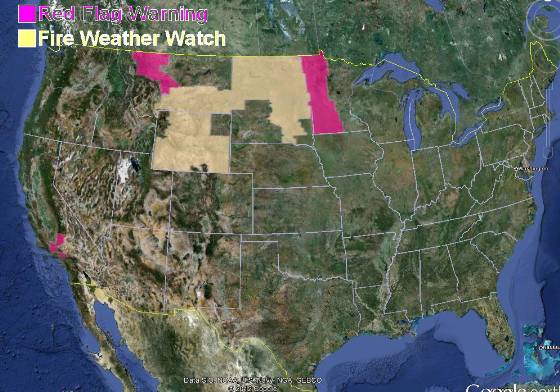
The map below shows the area in southern California covered by the red flag warning, which is in effect from 6 a.m. Monday until 6 p.m. PDT Tuesday.
There is also a red flag warning for some areas in northwest Montana for gusty winds and low humidities from 11 a.m. through midnight MDT on Monday. The winds are expected to be southwest at 15 to 25 mph with gusts up to 50, with the humidities as low as 16 percent.
The passage of a cold front has resulted in a red flag warning for western Minnesota from 2 p.m. until 7 p.m. CDT on Monday. Winds should be northwest at 20 with gusts up to 30 mph along with humidities as low as 20 percent.
A fire weather watch is in effect for areas in Wyoming, Montana, North Dakota, and South Dakota.
A jury has recommended that Rickie Lee Fowler be sentenced to death for starting the 2003 Old fire that destroyed 1,003 homes, burned 91,000 acres, and led to five deaths. He was convicted on August 15 of two arson charges and of murdering the five people who died of heart attacks after their homes burned or while they evacuated during the fire near San Bernardino, California.
The judge in the case has the legal authority to reduce the death sentence to life in prison, but that rarely occurs in California.
In the trial, the State employed the same principle used when prosecutors in neighboring Riverside County won a death penalty conviction against Raymond Lee Oyler, an auto mechanic who set the 2006 Esperanza wildfire that killed five federal firefighters. Oyler is believed to be the first person in the U.S. to be convicted of first-degree murder and sentenced to death in a wildland arson case.
Before the trial Mr. Fowler said he and three men in a van had intended to rob John Aylward, a person he identified as his godfather, but realized they were too drunk or stoned to pull it off. Instead, they decided to start a fire, as one person testified before a grand jury, “to burn John’s house down”.
In an interview with investigators, Mr. Fowler said he struck the flare and threw it into the vegetation, but corrected himself and said one of the other men in the van struck the flare. In a later interview, he said he intended to strike and throw the flare, but Martin Valdez Jr. took it from him, struck it, and threw it into the brush.
While in prison before the trial, Mr. Fowler was convicted of sodomizing another jail inmate and sentenced to three 25-years-to-life prison terms.


 Firefighting resources have been prepositioned in southern California for the last two days in order to be ready for any wildfires that break out during the predicted strong Santa Ana winds. There has been “light initial attack” fire activity over the last couple of days, according to the Southern California Geographic Area Coordination Center, but no large fires so far. Maybe this can be credited not only to the not-quite-as-strong-as-expected winds, but to aggressive initial attack by the fire agencies. One fire near Fontana burned a few hundred acres before firefighters put it out. Photos of that fire by tjvphoto can be found HERE.