A new study report from the University of Oregon suggests that public warnings on wildfire smoke air quality often aren’t issued till after smoke has already swept into the area. The report details recommendations on better communications by public institutions about wildfire smoke and health risks — so that local residents have more time to prepare. More than half of wildfire-related tweets by 32 institutional accounts in 2022 were posted at peak levels of smoke when exposure risk was highest.
“On the one side, these institutions are doing a great job of highlighting the risks when the risks are present,” said Catherine Slavik, a postdoctoral researcher at the U of O Center for Science Communication Research. She said she hopes more of these conversations will occur before it’s too late for affected residents to prepare.
KEZI reported that of 1287 analyzed tweets, only one in seven instructed and encouraged preparation such as wearing respirators, staying indoors, or using air purifiers. Only 213 of all the tweets used AQI labels to report on the smoky air and only 64 described risks with numeric data — such as percentage likelihood of a fire spreading or the number of acres burning.
Recommendations for smoke communications include expressing hazard severity, risk, likelihood, and mitigation, including numeric information and AQI levels when describing risks, practicing community engagement, and discussing risks outside of the fire season.
Wildfire simultaneity, or numerous large wildfires burning at the same time, will become at least twice as frequent by 2085, researchers are warning. A steadily increasing number of large wildland fires — and the number of acres burned — has occurred over the past few decades in the American West, but new research has found that simultaneous large fires will burn even more often.
“Future regional increases in simultaneous large Western USA wildfires” was published in the International Journal of Wildland Fire by the University Corporation for Atmospheric Research; it focused on wildfires that burned 1,000 acres or more between 1984 and 2015. Researchers used multiple fire indices to model how simultaneity will likely change over the next 60 years. The study also measured the fires by Geographic Area Coordination Centers to see whether some geographic areas might see greater increases compared with others.
Simultaneous wildfires were projected to increase in every area of the West. Not only were “bad years” projected to increase, but increases in simultaneity also led to more intense wildfires. Peak season for simultaneous wildfires was projected to become several weeks longer by the end of the century.
“The trend was particularly pronounced for the most severe wildfire seasons — those that currently occur only every 10 years on average,” the National Center for Atmospheric Research said. “In the future, such seasons may be expected to occur at least twice as often, and up to nearly five times per decade in the northern Rocky Mountains, which was the most affected region.”
Projected seasonality of simultaneity
The findings point toward a risk in an already understaffed and under-resourced wildland firefighting force. Because crews are transferred across the nation, or sometimes even across nations, to battle fires depending on when an area’s season peaks, an increase in peak season length could mean major challenges for firefighters and fire managers.
“Because firefighting decisions about resource distribution, pre-positioning, and suppression strategies consider simultaneity as a factor, these results underscore the importance of potential changes in simultaneity for fire management decision-making,” the study says.
Steps can reportedly be taken to lessen the future risk of simultaneous wildfires, including thinning forests, conducting prescribed burns, and increasing numbers of firefighting crews and equipment. But that will depend on how long it will take to make those changes.
“The strain on resources created by simultaneous fires can affect the ability to conduct prescribed burns and pursue other preventative action,” the center said.
Keeping wildland fires from spreading to human communities is the first and foremost priority of the U.S. Forest Service’s firefighters, according to the agency’s 2022 Wildfire Crisis Strategy Implementation Plan.
“Community exposure is a central factor in the strategy to confront the wildfire crisis,” the plan’s text reads. The plan goes on to identify what it called “high-risk firesheds” within National Forest Systems lands that it would focus on shifting land management towards increasing fuels and forest health treatments.
Recent research published in the Environmental Research Letters journal, however, found that the USFS hallmark decade-long plan misses the mark and doesn’t truly address what would stop more intense wildfires from igniting in the centuries to come: reducing carbon lost by wildland fire.
Conifer forests throughout the western U.S. play an integral role in sequestering and storing carbon in Earth’s atmosphere when these forests have a wildfire burning through them, carbon is not lost equally. Higher amounts of litter, duff and downed woody material consumed by fire, as well as post-fire decomposing trees, cause a greater risk of carbon loss. An increase in carbon output into Earth’s atmosphere will further increase the effects of climate change and, in turn, make wildfires more widespread and intense.
The study, a collaboration with the Forest Service, the Nature Conservancy, and University of Montana researchers, first evaluated where carbon was the most exposed and sensitive to wildfires. “Exposed” was defined as the largest concentrated areas of living and dead biomass’ burn probability, while “sensitive” compared areas for potential carbon loss and carbon recovery following wildland fire. They found that the most exposed carbon was not necessarily the most sensitive to wildfire.
“Relative to their total conifer forest area, states containing the greatest proportion of most exposed carbon … were California (63%), New Mexico (49%), and Arizona (44%),” researchers said. “In contrast, states with the greatest proportion of most sensitive carbon … were New Mexico (74%), Utah (67%), and Colorado (66%).”
Researchers then built upon the agency’s “high-risk firesheds” by combining high-risk areas for human communities and high-risk areas for wildfire-caused carbon loss.
Firesheds represented in gold to emphasize that improving reciprocal relationships between humans and forests can support multiple ecological, social, and cultural values concurrently.
“After overlaying our 308 opportunity hot spots on previously published maps of 140 high-risk all-lands firesheds for human communities, we observed that 64 firesheds overlapped,” the researchers said. “Here we represented those firesheds in gold to emphasize that improving reciprocal relationships between humans and forests can support multiple ecological, social, and cultural values concurrently.”
The University of Oregon in Eugene is launching a new research program to study effects of wildfire smoke and examine options for reducing risks. UO research professor Cass Moseley told KGW News that the center’s launch is due in part to efforts by Oregon’s U.S. Senators Ron Wyden and Jeff Merkley, who secured $800,000 in funding from the U.S. Environmental Protection Agency.
Research will focus in part on new ways to protect homes from smoke infiltration, along with more efficient communication with communities in emergencies and developing community action plans tailored to different regions in the Northwest.
The new Wildfire Smoke Research and Practice Center builds on research already completed through the Ecosystem Workforce Program (EWP), a joint venture between the UO and Oregon State University. KLCC reported that the EWP’s senior policy advisor Cass Moseley will head up the new center; she said recent incidents in the Pacific Northwest, particularly the 2020 Labor Day fires, highlighted the need for new smoke research. Much of Oregon, particularly the southern Willamette Valley, was choked with wildfire smoke for weeks during the 2020 fire season.
Those fires and the severe levels of smoke really emphasized the need for new research, according to Moseley. “And we saw this fall in Oakridge, several weeks of highly dense smoke as the fire there settled into that valley and really stayed; that community spent a lot of time and energy responding to that smoke event.”
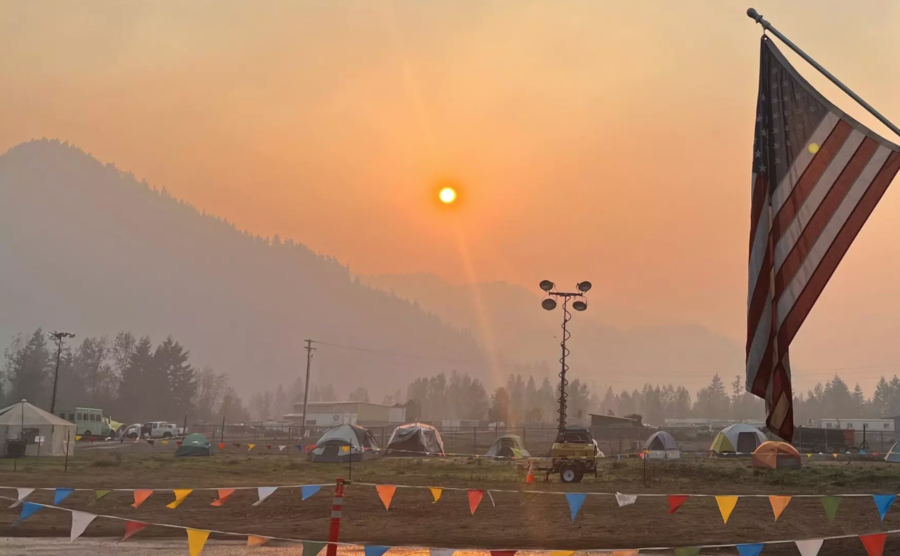
Cedar Creek Fire Incident Command Post in Oakridge, Oct. 15, 2022 — Inciweb photo
The center’s launch was announced by Merkley and Wyden, who secured the funding to help communities prepare for wildfire smoke. One area of interest is the toxins released when manmade structures burn, as these risks became obvious during western Oregon fires in wildland/urban interface areas over the last few years. Most smoke research has focused on burning timber and wooden structures, and part of the new planned research will study effects of smoke from burning plastics, glass, fuels, and other synthetic materials. Moseley said the center has three co-investigators and a principal investigator leading the group, along with research assistants and graduate and undergraduate student assistants.
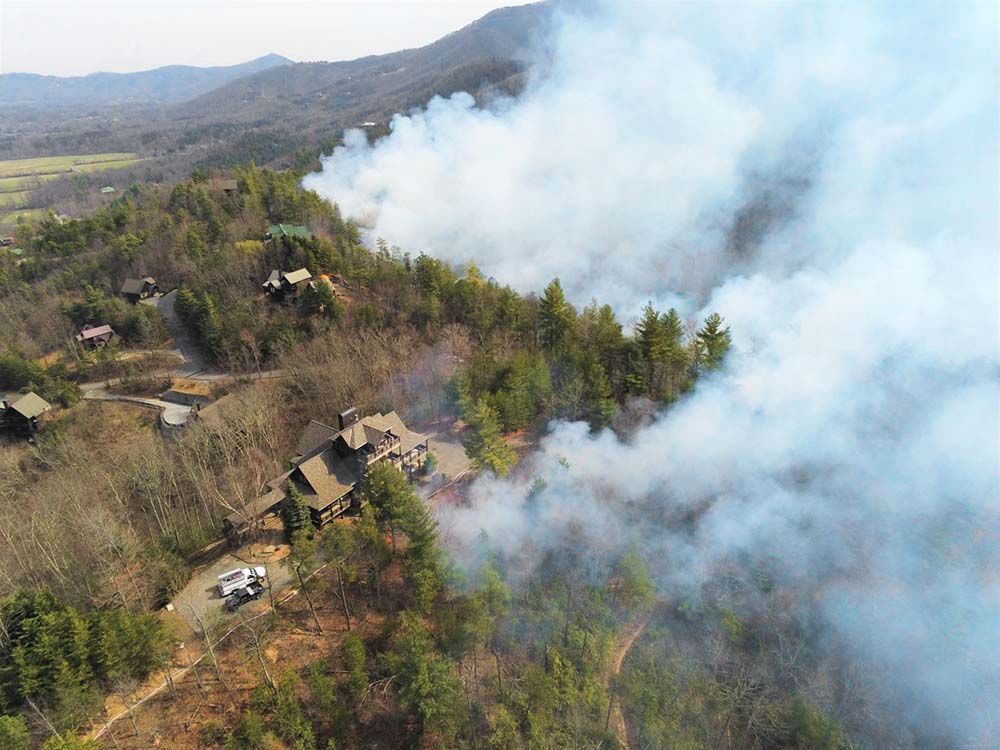
Prescribed fire in Great Smoky Mountains National Park, March 9, 2021. NPS photo.
The Joint Fire Science Program is offering grants for research into topics that can lead to more effective treatment of fuels. Examples include:
Longevity of fuel treatment effectiveness under climate change;
Fuels treatment effectiveness across landscapes;
Pre-fire management actions for reducing post-fire hazards; and
Social and political factors that influence fire suppression and rehabilitation costs.
The funding amounts for each of the four projects is expected to range from $300,000 to $500,000.
The new grant opportunities stem from the Bipartisan Infrastructure Law to advance research into wildfire prevention and post-fire restoration on federal lands.
The Joint Fire Science Program is accepting applications for grants to research innovative fuels treatments and post-fire rehabilitation efforts through Dec. 20, 2022, for fiscal year 2023.
Funding opportunities for wildland fire research priorities are posted on the Joint Fire Science Program’s website.
“With increasing wildfire activity due to climate change, it is imperative we fund research to better understand how to manage fire prone landscapes now and into the future,” said Grant Beebe, Bureau of Land Management assistant director of fire and aviation, based at the National Interagency Fire Center. “The Joint Fire Science Program brings the science and management community together in a unique, collaborative manner so that research can be used to make sound decisions on the ground.”
This funding is in addition to $3.4 billion in wildfire suppression and mitigation included in the Bipartisan Infrastructure Law.
This includes investments such as:
• $600 million to increase federal firefighter salaries by up to $20,000/year and convert at least 1,000 seasonal firefighters to year-round positions.
• $500 million for hazardous fuels mitigation.
• $500 million for prescribed fires.
• $500 million for communities to implement their community wildfire defense plan, a collaborative plan to address local hazards and risks from wildfire.
• $500 million for developing control locations and installing fuel breaks.
• $100 million for preplanning fire response workshops and workforce training.
• $40 million for radio frequency interoperability and to create Reverse-911 systems.
• $20 million for NOAA to create a satellite that rapidly detects fires in areas the federal government has financial responsibility.
• $10 million to procure real-time wildfire detection and monitoring equipment in high-risk or post-burn areas.
Wildfires may seem unpredictable, leaving random ruin in their wake. But it is based on science.
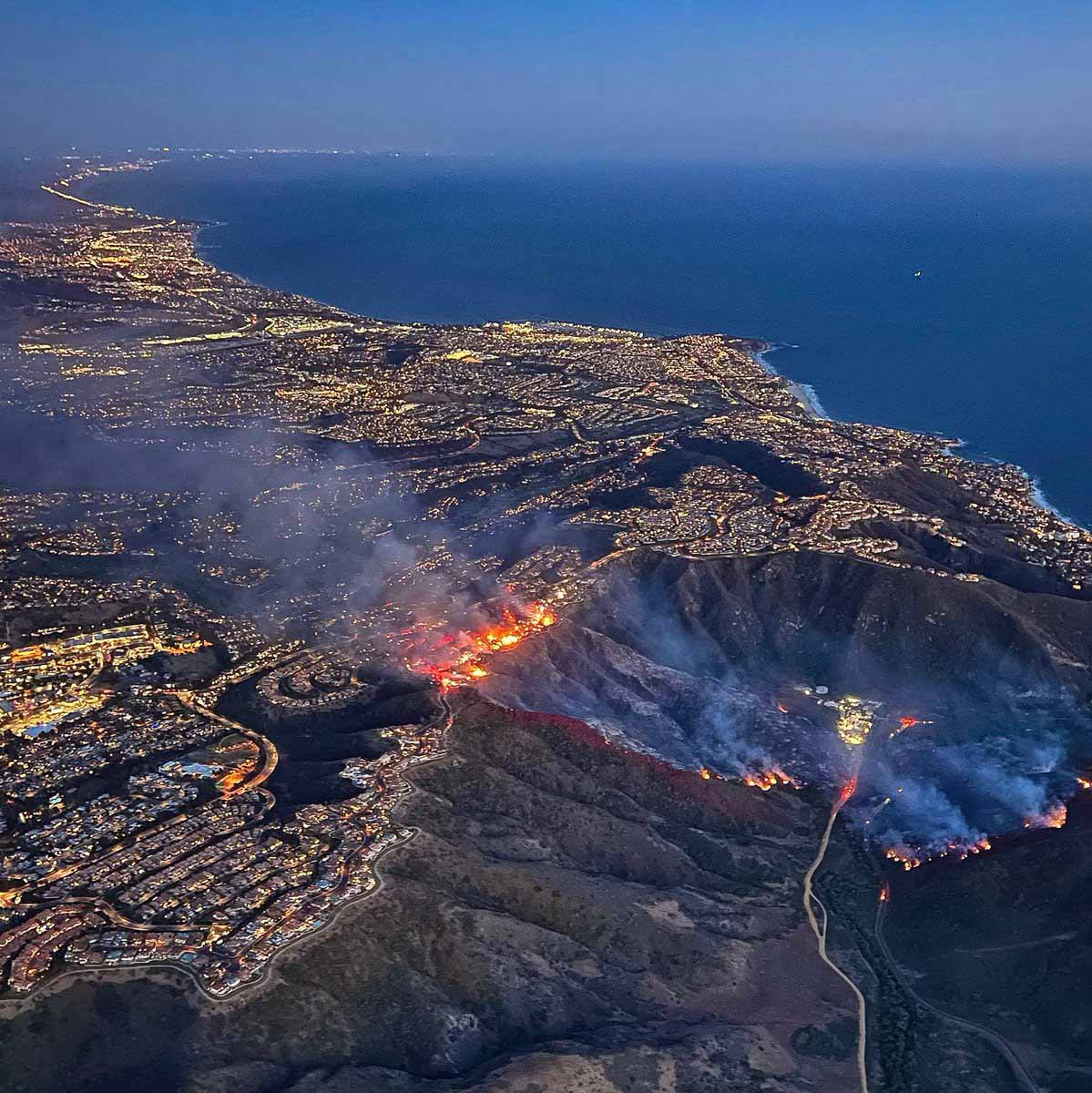
Coastal Fire, Orange County, CA, May 11, 2022. ABC7.
Six months ago we wrote about a project by the First Street Foundation which claimed to have developed a system for calculating the wildfire risk of 145 million properties in the United States.
We tested the system by entering property addresses for homes at two locations that were severely impacted by recent wildfires.
The Marshall Fire near Boulder, Colorado last year destroyed 1,091 homes and damaged 179. We looked up the Risk Factor for three properties in a community that had total destruction. The result was that they all had a 3 of 10 “moderate fire factor”, and individually a 1.84, 2.0, 1.84 percent chance of being in a wildfire over the next 30 years.
The Coastal Fire(see photo above) destroyed 20 homes in Laguna Niguel, California and damaged 11. The two we looked at in the zone with severe destruction received a 3 of 10 “moderate fire factor” with a 0.93 and 1.54 percent chance of being in a wildfire over the next 30 years. The homes were at the top of a steep brush-covered slope.
Another system
Colorado State University engineers have developed a model that they say can predict how wildfire will impact a community down to which buildings will burn. They say predicting damage to the built environment is essential to developing fire mitigation strategies and steps for recovery.
For years, Hussam Mahmoud, a Civil and Environmental Engineering professor, and postdoctoral fellow Akshat Chulahwat have been working on a model to measure the vulnerability of communities to wildfire. Most wildfire mitigation studies have focused on modeling fire behavior in the wildland; Mahmoud and Chulahwat’s model was the first to predict how a fire would progress through a community.
“We’re able to predict the most probable path the fire will take and how vulnerable each home is relative to the neighboring homes,” Mahmoud said. “We put a spin on the original model that allows us now to determine the level of damage in each building, whether the building will burn or survive.”
Using data from Technosylva, a wildfire science and technology company, Mahmoud and Chulahwat tested their model on the 2018 Camp Fire and 2020 Glass Fire in California. The model predicted which buildings burned and which survived with 58-64% accuracy. Since publishing their results in Scientific Reports, they have predicted which buildings burned with 86% accuracy for the Camp Fire by adjusting how the model weighs certain factors that contribute to damage.
Mahmoud says a holistic approach is needed to understand wildfire behavior and bolster resilience. Models that incorporate a community’s wildland and built environment features will give decision-makers the information needed to mitigate vulnerable areas.
Wildfire is like a disease
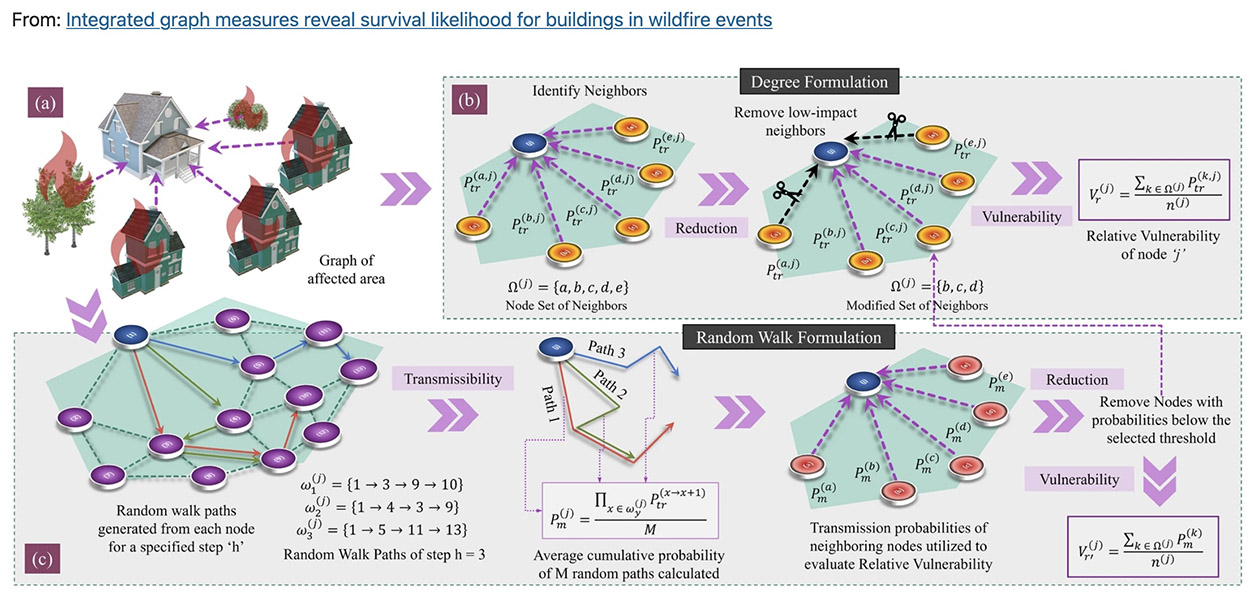
To develop their model, Mahmoud and Chulahwat employed graph theory, which is used to analyze networks. These methods also are used to study how diseases spread.
“Wildfire propagation in communities is similar to disease transmission in a social network,” Mahmoud said. Fire spreads from object to object in the same way contagions pass from one person to another.
Proposed relative vulnerability framework based on Degree ??? and Random walk ???? concepts implemented on (a) formulated graphs of the selected testbeds. (b) The modified degree formulation involves the following steps—(1) neighboring nodes identification, (2) Removal of low-impact connections from neighbors, and (3) Relative Vulnerability calculation. (c) The modified random walk formulation includes—(1) Generation of random walks of specific step length for each node, (2) Transmissibility calculation based on random walks generated, (3) neighboring nodes identification, (4) Removal of low transmissibility neighbors, and (5) Relative vulnerability calculation.
Wildfire mitigation strategies are like the tactics used to control the spread of COVID-19, he said. A community’s immune system can be boosted by mapping a structure’s surroundings (contact tracing), clearing defensible space around structures (social distancing), reinforcing structures to be more fire resistant (immunization), and creating a buffer zone at the wildland-urban interface (closing borders).
Some homes are like super-spreaders — they are more at risk of fire and more likely to transmit fire to other homes. By targeting certain homes or areas for reinforcement, policymakers could maximize a community’s mitigation efforts, Mahmoud said.
As wildfire risk is compounded by more people moving to wildland-adjacent areas and climate change drying out the landscape in arid regions, the researchers hope their model will help protect communities from the devastating losses wrought by wildfires.
“Fire science is not rocket science—it’s way more complicated.”
Robert Essenhigh, Professor Emeritus, Mechanical and Aerospace Engineering, Ohio State University.