
The company has 11 DC-3’s
Continue reading
The company has 11 DC-3’s
Continue reading
Thomas Fire. Photo credit: Ventura County Fire Department.
Ranchers in Ventura County who lost cattle and property during the devastating Thomas Fire filed a lawsuit this week against Southern California Edison, claiming the utility’s outdated equipment and lagging fire mitigation efforts were to blame for what became the largest blaze in modern state history.
“The Thomas Fire was the inevitable byproduct of SCE’s willful and conscious disregard of public safety. SCE, although mandated to do so, failed to identify, inspect, manage and/or control vegetation growth near its power lines and/or other electrical equipment. This created a foreseeable danger of trees and/or other vegetation coming into contact with SCE’s power lines and/or other electrical equipment and causing electrical problems, including ignition of fires,” the complaints state.
The lawsuit, filed on behalf of two ranchers, is the latest in a series of suits lodged against the utility provider.
According to The Ventura County Star newspaper, a spokesman for Edison said the company would not comment until the official cause of the blaze has been released.
“The Thomas fire obviously has had an impact of many individuals, but the origin and cause of the fire continue to be under investigation and no report has yet been issued,” a spokesman said in a statement, as reported by the newspaper. “This and other lawsuits are not based on findings related to an investigation. Therefore, it would be premature for SCE to comment on the origin or cause of the recent wildfires.”
The Thomas Fire burned 281,893 acres, making it the largest wildfire in recent California history. It destroyed 1,063 structures, damaged 280 more, and set in motion the factors that led to a series of flash-floods and landslides that killed 21 residents.
A report on the official cause may still be several weeks away.

In spite of that, the numbers of air tankers and helicopters are being slashed
Continue reading
Firefighting and warfighting are both expensive
Continue reading
Above: Students use sand tables to visualize initial attack scenarios and learn how to make sound decisions in this S200 Initial Attack Commander course during the 2018 Arizona Wildfire and Incident Management Academy in Prescott, Arizona. Courtesy photo.
An annual wildfire training camp’s enrollment ballooned to record numbers this year on the heels of an especially active fire season — and the release of Only the Brave.
At least 1,020 students are partaking in the 51 classes offered at this week’s Arizona Wildfire and Incident Management Academy in Prescott, said Tony Sciacca, Executive Director of the academy, as reported by The Daily Courier in Prescott. In its 16 years of operation, the academy’s previous highest enrollment was 730.
The academy has a capacity of 1060.
“It’s a significant jump,” Sciacca told the newspaper.
During the training, which began March 10 and lasts through Friday at Embry Riddle Aeronautical University, attendees can pick from more than 50 NWCG, FEMA and other skills classes. Class offerings range from the entry-level S-130/190 to more advanced leadership or communications roles.
The Goodwin Fire burned 28,500 acres just outside of Prescott last year. That, along with high-profile wildfires in California, might have piqued some interested in the academy, which is largely attended by Arizonans.
Additionally, there stands to be more money to go around this year. Arizona’s governor last month called for the doubling of the state’s investment in fire prevention funding for the upcoming fiscal year, from $1 million to $2 million.
And while it’s impossible to say, interest in wildland firefighting has surely increased since October’s release of Only the Brave. That film, of course, is based on the Granite Mountain Hotshots that fought not only wildfires for several years, but also battled with the establishment to finally be certified as the first Type 1 Interagency Hotshot Crew managed by a municipal fire department — the Prescott, Arizona Fire Department.

Above: Ron Hooper, CEO of Neptune Aviation
Earlier we posted Part One of a few notes that I scribbled in a notebook at the Aerial Firefighting conference in Sacramento this week. Here is Part Two.
Neptune Aviation
Ron Hooper, CEO of Neptune Aviation, said their air tankers in 2016 averaged 180 hours while working on wildfires. In 2017, a very busy year, that number increased to 276. Their P2V’s have retired from firefighting, leaving the company with nine air tankers, all BAe-146’s.
No one outside the U.S. Forest Service knows when the agency will issue the next round of exclusive use and call when needed next-generation air tanker contracts, affectionately called Next-Gen 3.0. When forced to guess, Mr. Hooper said the aircraft receiving those new contracts may not be activated until 2019. He may know more than most, since his former job was supervising air tanker contracting for the FS.
Phos-Chek
One of the major suppliers of fire retardant, Phos-Chek, is changing hands again. In a matter of days its parent company will be Perimeter Solutions. But as in the previous four iterations it will retain the brand name Phos-Chek.
Here is the product’s history of parent companies:
1963-1997: Monsanto
1997-2000: Solutia
2000-2005: Astaris
2005-2018: ICL
2018- ???? : Perimeter
Global Supertanker
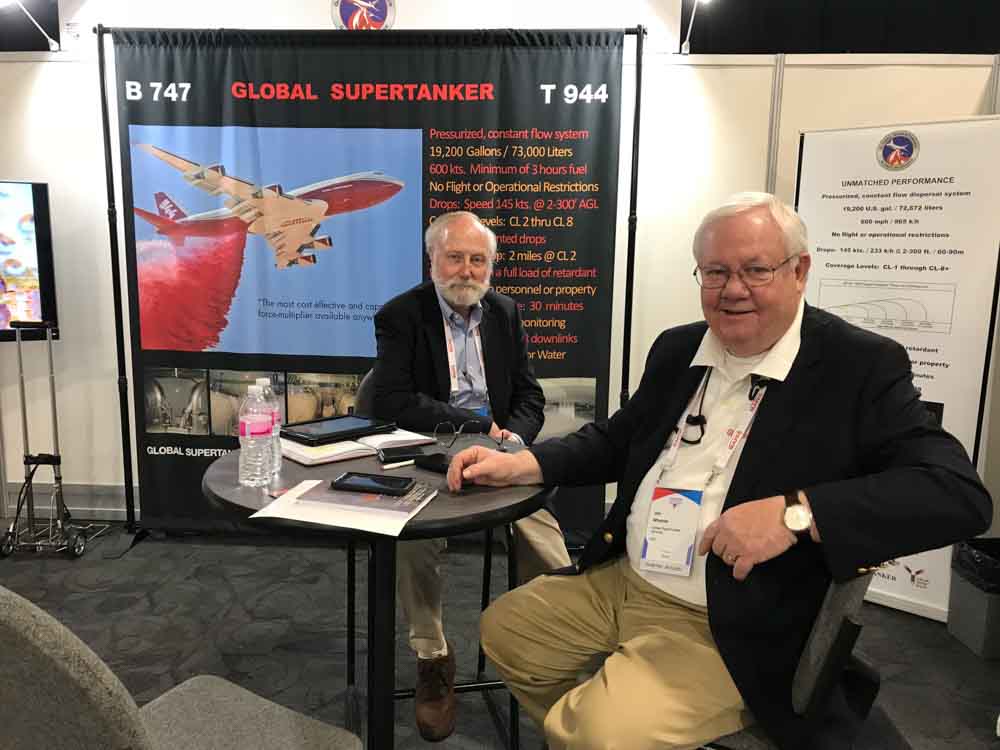 L to R: Bob Soelberg and Jim Wheeler of Global Supertanker
Jim Wheeler, CEO of Global Supertanker Services, said the company currently has CWN contracts with CAL FIRE and two counties in Colorado — Douglas (just south of Denver) and El Paso (Colorado Springs). Other pending contracts that they hope to sign later will be with the states of Colorado, Texas, and Oregon.
Colorado
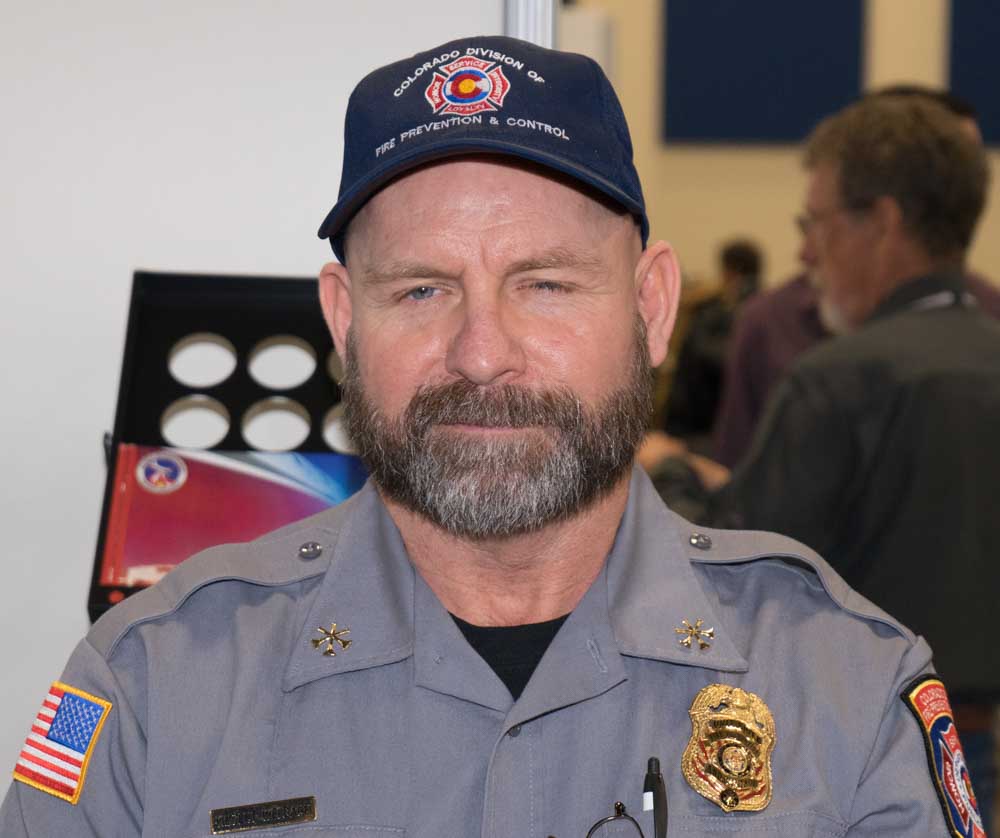 Vincent Welbaum, Colorado’s Aviation Unit Chief
, said they are talking to vendors and expect to award a call when needed contract to at least one vendor that can supply large or very large air tankers. The state has been operating their own two Pilatus PC-12 Multi-mission aircraft for several years, using it to detect and map wildfires.
Colorado will have two Single Engine Air Tankers on exclusive use contracts supplied by CO Fire Aviation and Aero Seat as well as four other vendors on call when needed contracts. The state will also have two Bell 205’s on exclusive use contracts.
Helimax
 Pat Pilolia, of Helimax
Helimax Aviation is one of two subsidiaries of Heligroup Holdings. The other is CHI at Howell, Michigan which concentrates on heavy lift, while Helimax, at Sacramento McClellan Airport is in involved in aerial firefighting. Helimax recently sold all of their Type 2 helicopters, and now have six Type-1’s, Chinook CH-47D’s.
MAFFS Group
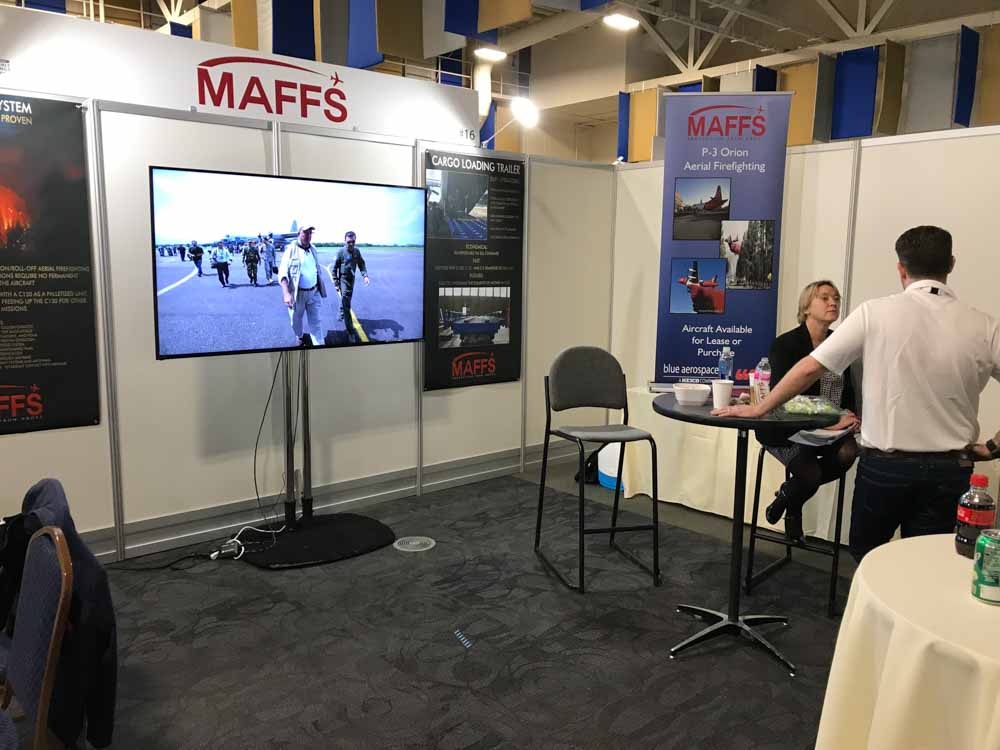 Bradford Beck, COO of MAFFS Group said the company recently sold a MAFFS II system to the Tunisia Air Force in Northern Africa. The country has operated two of the original versions of the MAFFS for 10 to 15 years. They will continue to operate the MAFFS I systems on a C-130B and will use a C-130H for the new MAFFS II which will be delivered in the third quarter of this year. The most challenging wildfires in Tunisia occur in the Atlas mountains.
This is the second MAFFS II that the MAFFS Group has sold. The first is now being used in Columbia, South America.
Viking Air
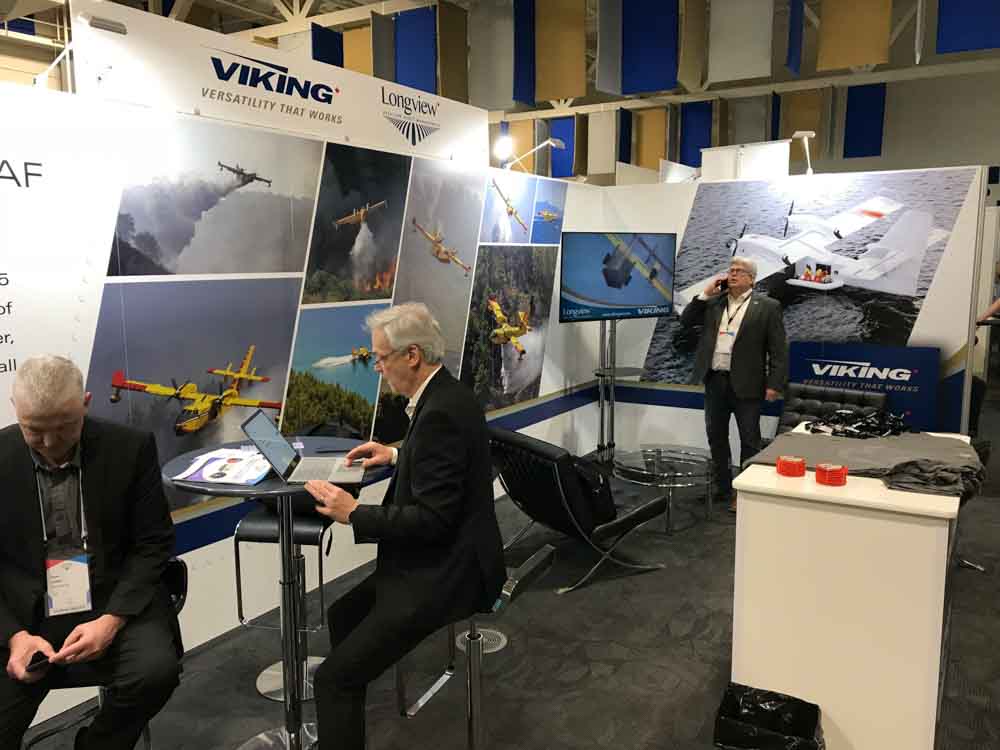 The Viking Air display at the conference.
Viking Air director of Special Projects, Sales, and Marketing Christian Bergeron said the company is currently gathering information from potential customers about what they would like to see on a new version of the CL-415 water scooping air tanker. The company expects to decide by the third quarter of this year if they will proceed with the project, which will be named CL-515. At this stage, Mr. Bergeron said, they expect it to have a larger cargo door, glass cockpit, updated avionics, and will be able to land with a full load of water. Available options will include an infrared camera system and night vision compatibility. Viking’s manufacturing facility is in Calgary, Canada.

Photo: Hutchinson Kansas Fire Department
A series of wildfires raced through grasslands in rural Kansas Wednesday, scorching swaths of land and drawing local firefighters and the Kansas National Guard.
The fires began midday Wednesday, primarily in Rice County in central Kansas. Fanned by gusty winds, the fire quickly became visible on radar imagery and the GOES-16 Satellite, as shown in these images from the National Weather Service’s Wichita bureau.
“Wind is the huge factor in the tall grass,” Rice County Emergency Management Director Greg Kline told reporters at the scene of one of the fires. “Access to some of these locations is very tough at times.”
Details about the estimated number of acres burned were not immediately available. But Kline said the three separate fires in Rice County were estimated to be about 2 miles wide and about 4 miles long at their farthest points.
https://twitter.com/hutchdcdoug/status/974083926154252293
Video of the news conference was posted by The Hutchinson News.
Neighboring counties were assisting local crews, and firefighters were expected to be in the area through the night.
A crop-duster was also being used to help.
Kansas Gov. Jeff Colyer on Wednesday morning made an emergency declaration for three of the fires burning in Rice County and deployed Black Hawk helicopters from the Kansas National Guard to assist in the response.
Much of the state has been under red flag warnings in recent days.
Plus, the entire state is currently classified as “abnormally dry” with a large pocket of southern Kansas categorized as being in an “extreme drought,”
 Drought monitor, March 1, 2018. National Drought Mitigation Center.
Very high and extreme fire danger is anticipated for Thursday and Friday, with forecasted temperatures in the 70s and wind gusts up to 30 mph. Cooler temperatures and rain could be on the way for the weekend, according to the National Weather Service.

Above: the Air Tractor display at the Aerial Firefighting conference.
Here are a few notes that I scribbled in a notebook at the Aerial Firefighting conference in Sacramento this week. This is Part One — I will post Part Two later.
Air Tractor
Mike Schoenau, an Air Tractor dealer out of Tulare, CA, said a new single engine air tanker is being flight tested now. The model name is AT-1002 and will hold up to 1,000 gallons. You will be able to purchase one for yourself for about $2.5 Million.
Fire Boss
 The Bureau of Land Management has not released their list of SEATs on contract this year, many of which will be the amphibious Fire Boss, a variant of the Air Tractor 802. Fire Boss doesn’t know if they will be converting the new AT-1002 1,000-gallon SEAT to use floats.
10 Tanker
 RIck Hatton of 10 Tanker Air Carrier.
Their fourth converted DC-10, Tanker 914, will be ready to fight fire this summer. Rick Hatton, the President and CEO of 10 Tanker Air Carrier, said their approval by the Interagency Airtanker Board came to the end of its six-year term, so they retook the grid test in December. Their three DC-10s averaged about 300 hours on fires in 2017, which is more than usual.
I got into a long detailed conversation with Mr. Hatton about how their retardant delivery system can maintain a constant flow, adjusting for the amount of retardant in the tank, drop height, and speed. It usually drops at 150 knots and 200 feet.
Hours per CL-415
As we reported yesterday, Shawna Legarza, the USFS Director of Fire and Aviation, said the two CL-415 scooping air tankers that were on USFS contract in 2017 each had over 400 hours of fire flight time. Due to a reduction in the firefighting budget, the two scoopers had to be cut this year from the exclusive use list. At least a couple are still on a CWN contract, but they may or may not be available if the USFS Calls them When Needed.
Columbia
 Keith Saylor, Columbia’s Director of Commercial Operations, said the company will have three Type 1 helicopters, CH-47 Chinooks, on exclusive use contract this year. Two have internal tanks and one will use an external bucket.
Conair
 Shawn Bethel, Conair’s Director, International Business Development, said the external tank on the Q400 can be removed in about three hours by 9 to 12 workers. They recently received a contract to supply six Q400’s to France’s Securite Civile (Department of Civil Defense and Emergency Preparedness).
The Q400 MR can carry up to 10,000 liters (2,600 gallons) of water or retardant. In addition to the nine S-2’s and two Q-400’s, France also has twelve CL-415’s and 40 helicopters.
Barry Lloyd describes the coming transition from Hueys
Continue reading
We interviewed Chief Pimlott at the Aerial Firefighting conference in Sacramento, March 13, 2018.
Continue reading