CNN reporter mischaracterizes the arson crimes of Oregon ranchers

CNN Oregon occupation report
CNN reporter Paul Vercammen (on the right) reports from the federal building break-in and occupation in Oregon, 12:21 p.m. PST, January 4, 2015. Screen grab from CNN.

In a live report today at 12:21 p.m. PST from the scene of the federal building break in and armed occupation at the Malheur National Wildlife Refuge in Oregon, CNN reporter Paul Vercammen mischaracterized the crimes committed by the two ranchers that triggered the protests and federal property take over. Mr. Vercammen, in explaining what led to the occupation, described the actions of Dwight Hammond, Jr., and his son, Steven Hammond:

[the protesters occupying the buildings] all do agree that the Hammonds should not be facing these indictment charges, going to prison again for arson on their own property.

First, they are not facing “indictment charges”. The two were convicted in federal court and given sentences well below the mandatory minimum sentence required by U.S. law. The U.S. Attorney appealed the sentences, since they did not conform to federal sentencing laws, and the appeals court imposed the required five year sentence. The Hammonds appealed that revised sentence all the way to the Supreme Court and lost.

Below is how the U.S. Attorney described one of the cases for which the Hammonds were convicted by a jury, the 2001 Hardie-Hammond Fire in the Steens Mountain Cooperative Management and Protection Area:

Dwight Lincoln Hammond, Jr., 73, and his son, Steven Dwight Hammond, 46, both residents of Diamond, Oregon in Harney County, were sentenced to five years in prison by Chief U.S. District Judge Ann Aiken for arsons they committed on federal lands.

[…]

Witnesses at trial, including a relative of the Hammonds, testified the arson occurred shortly after Steven Hammond and his hunting party illegally slaughtered several deer on BLM property.  Jurors were told that Steven Hammond handed out “Strike Anywhere” matches with instructions that they be lit and dropped on the ground because they were going to “light up the whole country on fire.”  One witness testified that he barely escaped the eight to ten foot high flames caused by the arson.  The fire consumed 139 acres of public land and destroyed all evidence of the game violations…

In his live report on CNN Mr. Vercammen appeared to be sympathetic to the causes of the protesters and the convicted arsonists, providing only their side of the issues, while failing to give a balanced and objective description of the facts.

And then there is the text headline in the lower-third of CNN’s report: “Armed activists prepared to stay, defend themselves”.  DEFEND THEMSELVES? From what? Bearing weapons, they seized property belonging to all of the citizens of the United States and intend to give it to someone else.

Just before reporter Vercammen provided his live, one-sided evaluation of the occupation, Ammon Bundy gave a news conference at the Malheur National Wildlife Refuge. Mr. Bundy, who was involved along other members of his family in a similar armed dispute with the Bureau of Land Management in Nevada in 2014, spent much of his time in front of the cameras discussing the Hammonds legal situation and his opinion that the federal government is unfairly harrassing them.

(UPDATE: On January 5, 2016 we researched and assembled the facts about about the Hammonds over the last 20 years.)
Twisp River Fire: report released as injured firefighter leaves hospital

Twisp River Fire map

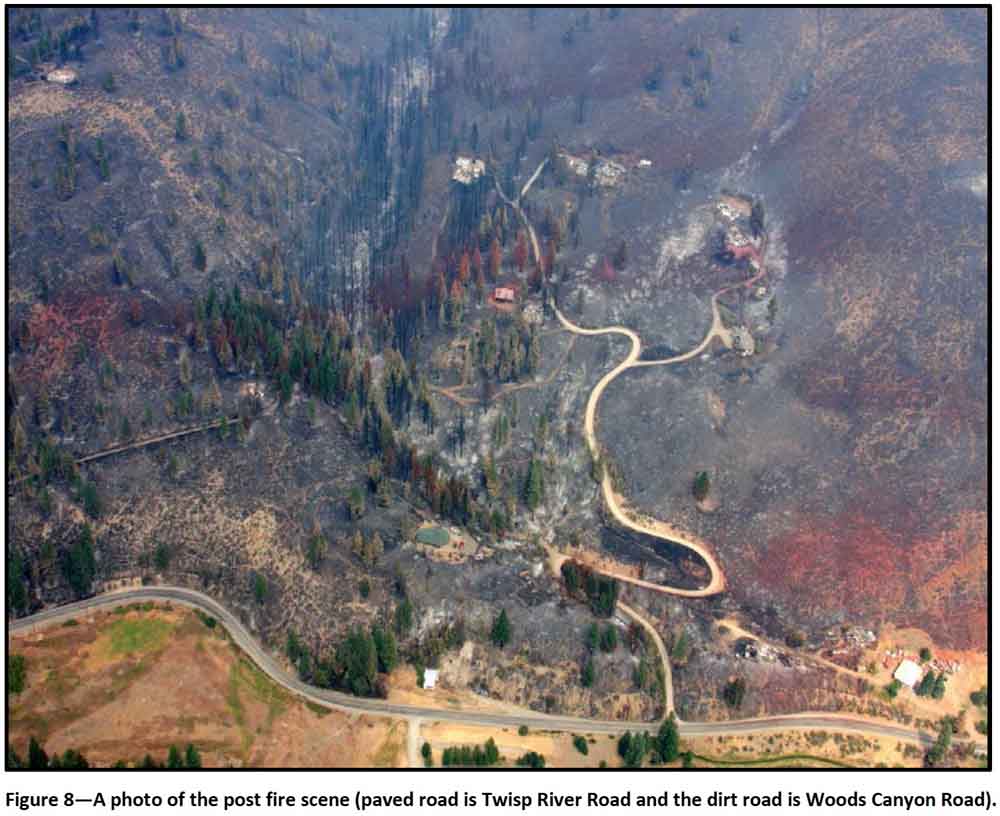
On November 18, the day a preliminary report was released for the Twisp River Fire, the firefighter who was severely burned on the incident west of Twisp, Washington left the Harborview Medical Center in Seattle.

Daniel Lyon Jr., 25, one of four people in Engine 642 assigned to the fire on August 19, left the vehicle after it crashed at about 3 p.m. while the crew was trying to drive to a safety zone through a very active part of the fire. He made his way through flames to a road where he was found by another firefighter. The two of them ran down the road until they found an Emergency Medical Technician Paramedic who provided initial treatment before Mr. Lyon was transported by ground ambulance and then a helicopter to the burn unit in Seattle.

The other three firefighters in Engine 642 died in the vehicle, according to the corner’s report, from smoke inhalation and thermal injuries. They were Richard Wheeler, 31; Andrew Zajac, 26; and Tom Zbyszewski, 20. All four were employees of the U.S. Forest Service working on the Okanogan/Wenatchee National Forest out of Twisp, Washington.

After spending three months in the hospital and undergoing 11 surgeries, including several skin grafts, Mr. Lyon still has a long road to recovery ahead of him. He suffered third degree burns over nearly 70 percent of his body. The tips of his fingers had to be amputated because his hands were so badly burned, said Dr. Nicole Gibran, director of the burn center, at a news conference on Wednesday. 

In addition to the four firefighters in Engine 642, a three-person dozer crew was entrapped when a wind shift caused the fire to spread in their direction. The extreme fire behavior that resulted, forced all fire personnel on the right flank of the fire to seek safety zones — if they could.

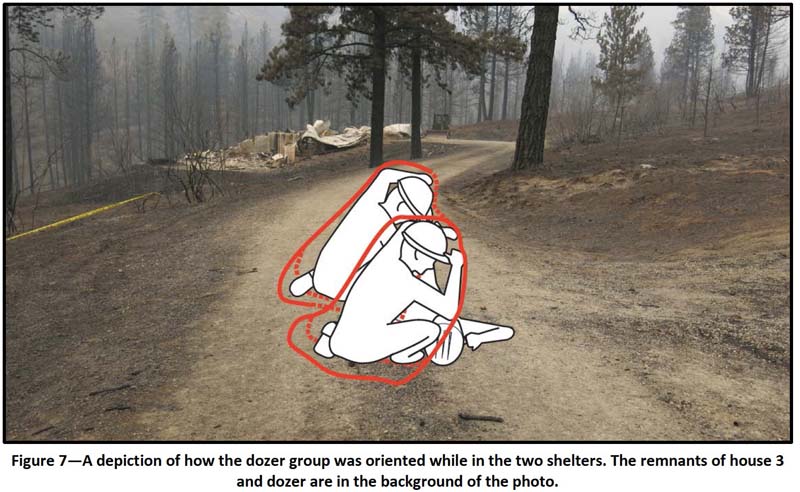
As the fire overtook them, the dozer crew initially parked the dozer near a garage and took refuge between the structure and the tractor. When one of them exited the dozer, he left his shelter, thinking he would not need it. Intense heat drove the three of them inside the garage. After the building began burning, they went outside and huddled under two fire shelters on a dirt road. 

Dozer Crew two fire shelters

Below is an excerpt from the preliminary report, from the section about the engine crew’s accident:

…The right side “point of contact” saw Engine 642 driving up to him, so he whistled and swung his hand over his head, indicating they needed to turn around and get out. The “point of contact” yelled, “RTO! [Reverse tool order!],” meaning that all crews needed to follow their escape route back down the road to the safety zone. Engine 642 turned around in the road and was the first engine to head toward the escape route. One of the other 3 engines turned around at the “Y,” and another engine drove up to house 4 to turn around. The fourth engine remained at house 3.

As Engine 642 drove down toward the safety zone, the road was completely obscured by smoke. The engine jolted and dropped down as if a tire had popped. They kept driving downhill, but they had zero visibility, and the engine went off the road. The engine came to a stop, and the surviving firefighter [Mr. Lyon] got out and was immediately engulfed in flames. He went through the flames and made his way to the road…

The document released on November 18 is called an “Interagency Learning Review Status Report”, one of many stages of the Learning Review process that was adopted by the USFS in 2013. It only includes facts, some of them, that have been developed so far in the investigation. It contains no conclusions or recommendations, and does not place blame. It does, however, present some very general “questions to initiate dialogue” related to protecting structures, the use of Type 3 Incident Commanders on a developing fire, communications (as usual in EVERY report), and the use of fire weather forecasts. The narrative in the report is “abridged”, with the full narrative expected to be part of the final report. Eventually a Safety Action Plan with recommendations will released and made available to the public, according to the preliminary report.

The preliminary report released on November 18 can be downloaded here.

The images above are from the report.

NIST releases report on Waldo Canyon Fire that burned 344 homes and killed two people

waldo canyon fireThe National Institute of Standards and Technology has released a lengthy report on the Waldo Canyon Fire that burned 344 homes and killed two people in Colorado Springs, Colorado in June, 2012. (It can be downloaded here, but is a large file.)

The 216-page document covers firefighting tactics, how structures ignited, defensible space, and how the fire spread, but does not address to any significant extent the management, planning, coordination, and cooperation between agencies, which were some of the largest issues.

The report was put together by five people, Alexander Maranghides, Derek McNamara, Robert Vihnanek, Joseph Restaino, and Carrie Leland.

At least three official reports have been written about the Waldo Canyon Fire, two from the city of Colorado Springs (here and here) and a third from the county sheriff’s office. However one of the most revealing was the result of an independent investigation by a newspaper, the Colorado Springs Independent, which revealed facts that were left out of the government-issued documents, including numerous examples of mismanagement by the city before and during the event.

The fire was first reported the evening of June 22, 2012 on the Pike National Forest. Due at least in part to the anemic response from the U.S. Forest Service, the fire was not located until after noon the following day. No aircraft were requested until firefighters were at the fire, more than 16 hours after the initial report.

The day the fire started there were eight large fires burning in Colorado and 16 uncontained large fires in the country. Four days later on June 26 when the Waldo Canyon Fire moved into Colorado Springs burning 344 homes and killing two people, there were 29 uncontained large fires burning in the United States.

However there were only nine large air tankers in the United States on U.S. Forest Service exclusive use contracts, down from the 44 we had 10 years before.

The 7-page Executive Summary of this newest report lists 4 primary findings, 37 technical findings, and 13 primary recommendations.

Primary findings:

  1. Defensive actions were effective in suppressing burning structures and containing the Waldo Canyon fire.
  2. Pre-fire planning is essential to enabling safe, effective, and rapid deployment of firefighting resources in WUI fires. Effective pre-fire planning requires a better understanding of exposure and vulnerabilities. This is necessary because of the very rapid development of WUI fires.
  3. Current concepts of defensible space do not account for hazards of burning primary structures, hazards presented by embers and the hazards outside of the home ignition zone.
  4. During and/or shortly after an incident, with limited damage assessment resources available, the collection of structure damage data will enable the identification of structure ignition vulnerabilities.

Three of the technical recommendations:

  • Fire departments should develop, plan, train and practice standard operating procedures for responding to WUI fires in their specific communities. These procedures should result from scientifically mapping a community’s high- and low-risk areas of exposure to both the fire and embers generated during WUI events (as will be possible using the WUI Hazard Scale).
  • A “response time threshold” for WUI fires should be established for each community. Fire departments have optimal “time-to-response” standards for reaching urban fires. Similar thresholds can, and should be, set for WUI fires.
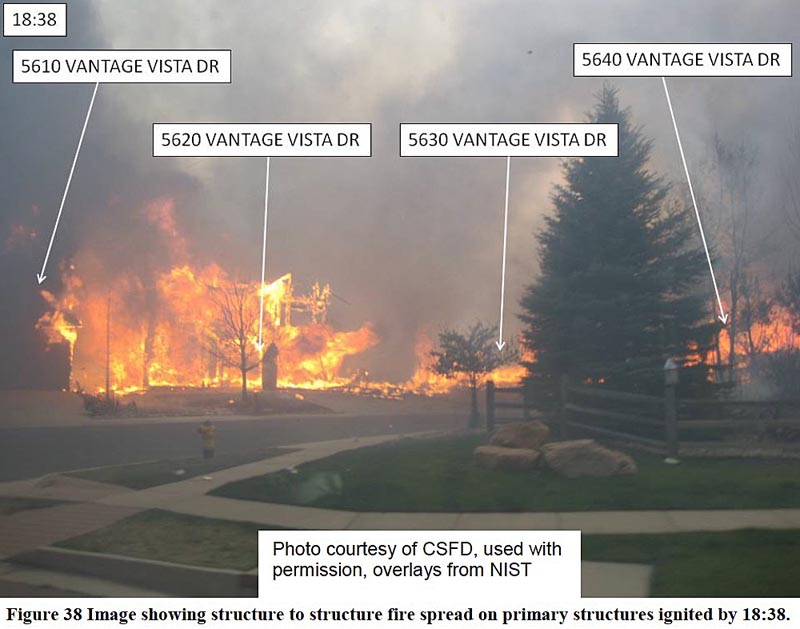
  • High-density structure-to-structure spacing in a community should be identified and considered in WUI fire response plans. In the Waldo Canyon fire, the majority of homes destroyed were ignited by fire and embers coming from other nearby residences already on fire. Based on this observation, the researchers concluded that structure spatial arrangements in a community must be a major consideration when planning for WUI fires.

Primary recommendations:

Continue reading

Incident Commander reportedly removed from team after incidents with landowners

Tepee Springs Fire
Tepee Springs Fire, posted on InciWeb August 28, 2015. Credit: Air Attack.
According to an article in the Idaho Statesman, the leader of the incident management team that was managing the Tepee Springs Fire has been removed from his position about six weeks after reports were filed on a website where firefighters can anonymously provide information about safety issues. Two reports were filed on the SAFENET website (on September 2 and 4, 2015) saying fire crews were ordered by the Incident Commander (IC) to construct fireline in an area agreed to in a meeting between the IC and the landowners who at times wore sidearms when they met with firefighters.

On several occasions  while talking to firefighters, the landowners had been very insistent that certain more aggressive tactics should be implemented. Our first article on this issue provoked a lengthy response from a person believed to be one of the landowners, or at least a person very familiar with the details who sympathized with them.

Rocky Barker, a writer for the Idaho Statesman, reported today that IC Chris Ourada, the fire management officer on the Caribou-Targhee National Forest in southeast Idaho, was taken off the Great Basin Type 1 Incident Management team that was assigned to the Tepee Springs Fire east of Riggins, Idaho from August 28 until September 12, 2015.

The latest roster for Great Basin Team 2 updated on October 7, 2015 lists Paul Broyles, who retired in 2008, as the IC. When we viewed the roster on September 27 Chris Ourada was the IC and Mr. Broyles was the Deputy IC. That earlier roster, dated February 2, 2015, has been deleted but can still be viewed on the Way Back Machine. Interestingly, the file name for the current roster is “Ourada_Master.pdf”.

It is very unusual for an Incident Commander to be replaced late in the fire season — on October 7 in this case. More commonly, major changes to a team are made in the winter.

The two SAFENET reports state that hotshot crews had not been constructing direct fireline on the edge of the fire near the private land due to numerous conditions that made that particular tactic unsafe, including cliffs in the area, the location made it impossible to extract resources if an injury occurred, no safety zones were available if fire behavior increased again, and the presence of a nearby under-slung mid-slope fireline.

Two hotshot crews refused to take on the risk of the direct fireline assignment. After explaining their rationale to the IC and the safety issues involved, the firefighters were reportedly told by the IC:

I’m the Incident Commander and you will do what you’re [expletive] told.

The official public response to the two SAFENET reports, issued October 5, 2015, said a “…team chartered by the Great Basin Coordinating Group [conducted] a review … and identified specific improvements and corrective actions, which are currently being implemented”.

Jennifer Jones, a national spokesperson about fire issues for the U.S. Forest Service in Boise, would not comment on the reported removal of an incident commander, except to refer us to a statement from the Regional Fire Director for the Intermountain Region, Sue Stewart:

Safety is always the top priority for the U.S. Forest Service.  Professional firefighters review all reports in SAFENET and ensure that appropriate actions are taken to correct any behaviors, systems or communication issues that could put fire fighters at risk. The Tepee Springs incident was thoroughly reviewed and appropriate actions were taken.

E. Wade Muehlhof, a spokesperson for the Intermountain Region which includes the area where the fire occurred, told us:

The decisions or recommendation made by the review panel are treated like personnel issues and are private.

In 1999 due to many mistakes, errors in judgement, and shear laziness by incident management team members on the Sadler Fire near Elko, Nevada that resulted in several firefighters being overrun by the fire, not only was the IC removed, but the entire team was disbanded. In addition, five members of the Command and General Staff had the fire qualification for their position on the team suspended until they could be recertified. The positions involved included the Incident Commander, the Planning Section Chief, the Safety Officer, and two Operations Section Chiefs.

More information on Wildfire Today:
—Our original article about the issues with the landowners and the incident commander.
—A further look into the landowner/firefighter disagreement in Idaho

Thanks and a tip of the hat go out to Chris.

Report released for fatality on the Frog Fire

Frog Fire fatality site photoThe U.S. Forest Service has released a preliminary report for the fatality of Dave Ruhl on the Frog Fire. Mr. Ruhl went missing the evening of July 30, 2015 while scouting the fire on foot, serving as incident commander during the initial attack in a very remote area of the Modoc National Forest 46 air miles east of Mt. Shasta, California. His body was found about 14 hours later approximately one-quarter mile from where he was last seen.

(Click on the image below, the timeline of the fire, to see a larger version.)

Frog Fire timeline

On August 4 the USFS said the autopsy determined that Mr. Ruhl’s death was attributed to “carbon monoxide poisoning and smoke inhalation”.

Not much information is in the report that sheds light on what led to his being entrapped by the fire, or what decisions were made or not made that led Mr. Ruhl to be in that spot at the wrong time. The wind direction did shift, which drove the fire in different directions, possibly resulting in his location becoming compromised.

The report’s narrative ends with this:

Although much will remain unknown about Dave’s decision making and complete route of travel, the final 100 feet of his route were accurately established. It appears he was cut-off and overcome by fire during the period of time that the fire spread shifted dramatically toward the west-southwest. Dave’s fire shelter was not deployed.

This document, called by the USFS a “learning review, preliminary report — narrative”, was released a little over two months after the fatality, a remarkably short amount of time for the agency. ItiPhone texts comes after the USFS was extremely secretive during the first five days after the accident, refusing to divulge if a fire shelter was deployed, where the remains were found, or if the fatality was caused by a burnover, vehicle accident, lightning, or another type of accident.

The report confirms something that could be occurring at many fires — behind the scenes communications via cell phones. The Zone Duty Officer sent two text messages to Mr. Ruhl confirming that he was a TRAINEE Type 3 Incident Commander, and ordering him to clarify that over the radio to the others on the fire. The next text message sent to Mr. Ruhl was, “And I won’t text anymore. Sorry for that.” And finally, an hour and a half later after it became obvious he was missing, “I need you to call or text ASAP, we are very concerned on your status.” The screen shot of those four messages from the Zone Duty Officer’s iPhone did not include any replies from Mr. Ruhl.

Dave Ruhl
Dave Ruhl

The full report can be downloaded (2.1 mb).

All of the above images are from the report.

Articles on Wildfire Today tagged Dave Ruhl.

Report released for entrapment of firefighters on the Valley Fire

Valley fire entrapment site
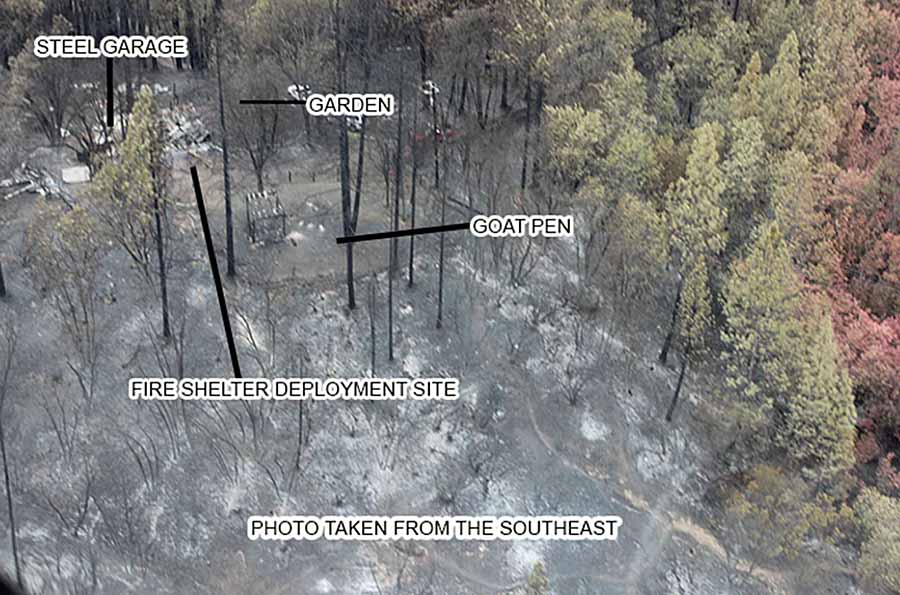
Entrapment site of firefighters on the Valley Fire. Photo from the CAL FIRE report. (click to enlarge)

The California Department of Forestry and Fire Protection (CAL FIRE) has released a report for an entrapment with injuries that occurred on the Valley Fire September 12, 2015. The fire burned 76,000 acres 62 miles north of San Francisco.

Four firefighters from a helitack crew that had arrived at the fire via helicopter were on the ground fighting the fire with hand tools when they were surrounded by the fire during initial attack operations and suffered serious burn injuries. Below is an excerpt from the report.

****

“…FC1 directed FF3, FF4 and FF5 to get into the goat pen, which was clear to bare mineral soil. While in the goat pen they observed the fire behavior changing. There was an increase in the wind speed, and an increased number of spot fires in the pine needle duff and leaf litter surrounding them. FF3 saw fire sheeting and swirling across the dirt driveway on the northwest side of the goat pen; several pines torched on the west side of the steel garage.

From the location of RES2, FF2 observed increased fire behavior advancing toward Helitack A’s location. FF2 communicated the increased fire behavior using the radio; FC1 acknowledged FF2’s observation.

At approximately 1402 hours, the brush covered slope to their east completely torched into a wall of flame. The wall of flame sent a significant wave of radiant heat through the goat pen and onto the firefighters. They could feel their faces burning from the radiant heat and all four firefighters ran to the fence, climbed over, and ran towards the steel garage. At the steel garage Helitack A started to deploy their fire shelters.

“May-Day” was transmitted from FC1 and was heard over the radio. From the location of a third residence (RES3), FC2 could hear FC1 say over the radio, “Four have deployed their shelters, near a barn on the right flank.” FF4 had difficulty opening the fire shelter case from the Chainsaw Pack; the clear plastic covering of the fire shelter was soft and melted. FF4 had to remove the gloves to tear the plastic away from the aluminum shell of the fire shelter. FF3 couldn’t get the fire shelter out of the case because the clear plastic cover was melted to the white plastic protective sleeve. FF3 looked up and saw FF4 at the north side (D) of the steel garage. FF3 dropped the fire shelter on the ground and ran to FF4’s location. FF3 and FF4 shared FF4’s fire shelter and stayed together in a crouched position. FC1 and FF5 deployed their fire shelters on the east side (A) of the steel garage. The heat in front of the steel garage was too intense so they moved to the north side (D) of the steel garage with FF3 and FF4 where the atmosphere seemed to be cooler.

Helitack A huddled together shielding the heat away from their already burned faces and hands; each of them could see the visible burns to one another’s faces and hands. FC1 continued to use the radio requesting bucket drops from C1 on their deployment location to cool the atmosphere. FF5 attempted to drink the water from the hydration pack but the water from the mouth piece was too hot to drink. While crouched in their fire shelters next to the steel garage, Helitack A suddenly heard explosions coming from inside the now burning structure. As a group, Helitack A moved a safe distance from the structure. Helitack A eventually crouched along the dirt driveway, separating the dirt garden and the goat pen.

From the driveways of RES3 and a fourth residence (RES4), FC2 directed C1 to make bucket drops into Helitack A’s location at the top of the ridge. C1 orbiting above and was unable to get near their location at the top of the ridge due to the thick column of smoke convecting straight up into the atmosphere…”

****

“Injuries:

  • FC1 suffered second and third degree burns to the head, face, ears, neck, back, arms, hands, legs and feet and has had several surgeries. FC1 remains in critical condition and is under the continued care of UCD Burn Center.
  • FF4 suffered first and second degree burns to the face, head, ears, arms and hands and is under the continued care of UCD Medical Center.
  • FF5 suffered first and second degree burns to the face, head, ears, arms, foot and hands and is under the continued care of UCD Medical Center.
  • FF3 suffered first and second degree burns to the face, head, ears, arms and hands and is under the continued care of UCD Medical Center.”

The report lists 13 “Safety issues for review and lessons learned”. Here are the first five:

  • “Crews must utilize L.C.E.S [lookouts, communications, escape routes, safety zones] when engaged in firefighting operations.
  • ALL Ten Standard Fire Orders MUST be obeyed at ALL TIMES.
  • Personnel MUST wear ALL CAL FIRE APPROVED PPE when engaged in firefighting operation.
  • Modifying Personal Protective Equipment can alter the protective properties.
  • Practice and prepare for shelter deployment in adverse and extreme conditions.”

Thanks and a tip of the hat go out to John.

Report: USFS won’t let forest ecologist talk about reforming fire management

Norbeck prescribed fire,
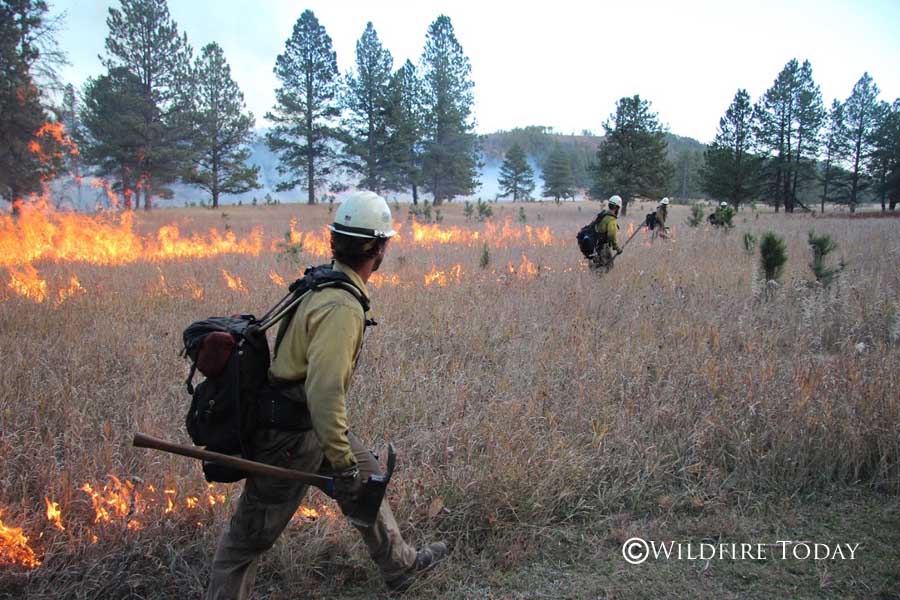
Alpine Hot Shots ignite the Norbeck prescribed fire in Wind Cave National Park, South Dakota. October 21, 2014. Photo by Bill Gabbert.
An article at Capital Public Radio claims that the U.S. Forest Service will not let a forest ecologist talk about an article he co-wrote titled “Reform Forest Fire Management”. The two-page opinion piece about making forests less prone to wildfire appeared in Science, and was written primarily by USFS and university employees.

Below is an excerpt from the article at Capital Public Radio about the controversy:

****

“The US Forest Service Pacific Southwest Research Station won’t let forest ecologist Malcolm North talk about the study he authored in the journal Science.

The agency even unsuccesfully requested that Science editors hold the article or remove North’s name and affiliation from the peer-reviewed study.  The paper “Reform Forest Fire Management” says suppressing every fire in overgrown forests is not only expensive but dangerous and ill-advised.

Strong words perhaps, but UC Berkeley Fire Scientist Scott Stephens, who co-authored the paper, says they are not controversial.

“I read the paper many times,” says Stephens. “I just didn’t see something jump, like this would be something that would really cause great problems.”

The study considers ways to make forests less prone to wildfire, by thinning trees in overgrown forests, using controlled burns or allowing natural fires to burn under the right conditions.

US Forest Service policy actually supports those actions, but the authors point out such efforts rarely occur. In the decade ending in 2008, only 0.4 percent of ignitions were allowed to burn as managed wildfires…”

Report of trouble with landowners on the Tepee Springs Fire in Idaho

(UPDATE, October 1, 2015: we further analyzed this incident in a new article, including additional information.)

According to a report filed on SAFENET, a private landowner in Idaho armed with a weapon aggressively accosted firefighters and interfered with fire suppression operations in several other ways. Law enforcement officers had to be called more than once and two hot shot crews refused an assignment ordered by the incident commander.

This occurred on the Tepee Springs Fire which is three miles east of Riggins, Idaho on the Payette National Forest. As of September 24, 2015 the fire has burned over 95,000 acres.

The “event start date” in the report was September 2, 2015 but the harassment apparently occurred over multiple days.

Records show that the Great Basin Incident Management Team #2, led by Incident Commander Chris Ourada, was assigned to the fire from August 28 until September 12, 2015.

It is not clear what person or position on the fire filed the report. This may be just one side of the story, but we will be interested to see if the charges in the report hold up, and what corrective actions will be taken, if there is a need for any, other than “[we are] looking in to this matter”, and “thank you”.

Below is the Narrative from the report. Following that is the “Immediate Action Taken”, and the “Corrective Actions”.

****

Narrative:

On Division Delta on the Tepee Springs fire a “turn down” of assignment occurred where two IHC’s refused an assignment due to numerous safety concerns that were not mitigated. These safety concerns will be addressed below. The IC of the incident responded to this turn down by stating “I am the boss, you work for me and you will do what I say. And I am saying go in there and go direct!” In response to this the crews still refused the assignment and were sent to another division the following day and remained on those divisions for the remainder of the assignment.

Division Delta on the Tepee Springs fire featured large tracts of private land mixed with State, Forest Service, and BLM land. A large elk ranch lay in the middle of the division and was the epicenter of the issues. The land owners, on multiple occasions expressed frustration towards fire fighters with their suppression actions which ranged from verbal threats to aggressive posturing. LEO’s were called on multiple occasions and the incident eventually resulted in two of the land owners verbally accosting a BLM employee while armed with a weapon. The land owners made multiple unsafe demands to fire fighters such as downhill line construction in extremely rugged terrain with fire below them, attempting burnouts on mid-slope dozer lines with no escape routes or safety zones, and to drop water from helicopters with personnel in the work zone (the land owners).

During at least one documented occasion the land owners took it upon themselves to attempt a burnout and began igniting fire below crews without any communication or warning. Crews had to be pulled to safe areas during this. Other unsafe suppression actions by the land owners were extremely fast driving, attacking fires at the head, felling trees in the middle of crews, and operating dozers on federal and state land with no communication with fire resources. In addition to the ill-advised suppression actions their continued harassment of fire line personnel in an attempt to force their own initiatives distracted important leaders from their primary jobs of managing people as well as the entire division and the fire as a whole.

Continue reading

Report that pieces of metal fell from Erickson MD-87 air tanker over Fresno, California

(UPDATE at 9:20 p.m PT, September 13, 2015)

KMPH reports that the pieces of metal that fell into a Fresno neighborhood Sunday afternoon September 13, breaking a car window, came from an engine that failed on an air tanker, reportedly an Erickson MD-87. Below is an excerpt from their article:

…The plane had departed the Fresno Airport around 3:30 p.m. Sunday when, according to the Federal Aviation Administration and Fresno Firefighters, the pilot reported a left engine failure.

Shortly after, families in a neighborhood near Ashlan and Highway 168 said they heard a boom and saw smoke coming from the plane.

In the process, pieces of the plane’s engine fell into a neighborhood. At least one piece shattered a windshield. Others landed on the streets.

The plane returned to the airport moments later…

****

(Originally published at 5:43 p.m. PT, September 13, 2015)

Medford tankers by Dave Clemens (4)
File photo of Tanker 101, an MD-87, at Medford in September, 2014. Photo by Dave Clemens.

Thanks and a tip of the hat go out to Barbara and Steve.
Typos or errors, report them HERE.

UPDATE, September 15, 2015: The Fresno Bee published an article on September 14 with additional information.

We don’t know what caused the engine to fail, and it might not be related, but here is a link to a story we ran in June of 2014 about all three of Erickson’s MD-87s being recalled“ due to intermittent engine surges when dropping [retardant at] high coverage levels”.