T -131 at San Bernardino, August 24, 2013. Photo by Dan Megna
(UPDATED at 1:47 p.m. PDT, September 20, 2012)
Tanker 131 was dispatched to its first fire today, September 20, near Santa Maria, California.
****
(Originally published September 13, 2013)
Coulson’s Air Tanker 131, a converted C-130Q, has been fully certified by the FAA, the Interagency AirTanker Board, and the U.S. Forest Service. The 3,500-gallon aircraft was carded on Tuesday and the pilot check rides occurred Wednesday. Its first assignment was to report to the San Bernardino airport, which ironically is where it spent the last several months while going through the conversion process.
Wayne Coulson, President and CEO of Coulson Aviation USA Inc., said, “This C-130Q has been outfitted with a Coulson RADS-XL Constant Flow tank and a state-of-the-art drop controller system that will enhance the accuracy of retardant drops by using GPS speed and other inputs.”
T-131 becomes the second air tanker to be certified and activated, of the original seven that were awarded “next generation” contracts.
As you may know, the USFS announced on May 6 that contracts were going to be awarded for seven next generation air tankers. The contracts were for exclusive use and for five years, with options for the USFS to extend them for an additional five years. Another option allows the addition of more air tankers from the vendors. The activation of the contracts was held up by two rounds of protests in 2012 and 2013 from Neptune Aviation, 10 Tanker, and Coulson, but the awards, after over 500 days of dithering, finally went to:
Only one of the five companies had their air tanker fully certified and ready to go when the awards were announced — 10 Tanker Air Carrier and their DC-10. They put Tanker 910 to work around June 1. In fact, their second DC-10, Tanker 911, was activated on a Call When Needed (CWN) contract June 14 (later changed to a 90-day exclusive use contract) and both of them have been flying fires since then. The two DC-10s, which always carry 11,600 gallons, dropped approximately 698,000 gallons of retardant in the month of June.
The mandatory availability period for the six next generation air tankers was supposed to begin in the first part of August, 2013. Other than the DC-10, none of them made that date. Minden, Aero Air, and Aero Flite are still working on their conversion projects.
Live streaming of memorial service for Token Adams
The memorial service for Token Adams, the firefighter who was killed in an apparent ATV accident while scouting a fire in New Mexico, will begin at 10 a.m. MDT today, Thursday, at KRQE and also KOBT.
Inmate firefighter truck rolls over in Arizona
An Arizona Department of Corrections crew carrier transporting a wildland fire crew rolled over Wednesday afternoon on State Route 79 near Florence, Arizona. Several inmates and one corrections officer were injured, but none of the injuries were considered life-threatening. It is unclear what caused the accident but authorities are looking for a newer white Chevrolet Tahoe or Suburban that may have been involved. The older male driver of the SUV is believed to have left the scene traveling south.
Deceased person found in Clover Fire in Northern California
On September 10, 2013 during the late evening hours, the Shasta County Sheriff’s Office located a deceased person inside the Clover Fire perimeter on Coal Pit Road in the community of Igo, California while conducting a welfare check. Next of kin was notified and the person has been identified as Brian Stanley Henry, 56. We send out our sincere condolences to the family of Mr. Henry.
Survey says voters have strong connection to national forests
A recent survey of voters commissioned by the National Forest Foundation concluded that they have a strong personal connection to National Forests. These connections are so strong that four in five voters polled said despite federal budget problems, funding to safeguard National Forests should not be cut. Seventy-two percent of voters surveyed would support additional funding to maintain and restore National Forest lands even if it meant a small tax increase.
Such supporters include groups that are traditionally more tax sensitive: 63 percent of seniors and 56 percent of conservatives said they would support additional funding even if it meant a small tax increase.
Forty-four percent (44%) of voters see uncontrollable wildfires as a serious problem. Just under half (44%) of U.S. voters say “uncontrollable wildfires that destroy property and forests” “is a serious problem, facing the nation” – with one-in-four calling it an “extremely” or “very” serious problem. This is the highest proportion to register this view since 2007. Concerns about this issue are drastically different by region, with 67% of voters in the West saying wildfires are an extremely or very serious problem and two-thirds deeming them to be at least somewhat serious.
Thief hit fire stations while firefighters fought wildfire
While crews in Walnut Creek were out fighting the Morgan Fire east of Berkeley, California Sunday night, a thief broke into Fire Station No. 7 and rummaged through lockers, desks and gym bags making off with money, an iPad, two firefighters’ wedding bands, and a watch. A second firehouse was also targeted, but a sleeping firefighter scared away the thief.
Since then, firefighters say they’ve received endless food donations, hundreds of dollars in gift cards, and offers from multiple jewelry stores to replace the stolen rings.
Tanker 131 certified
T 131 taxiing. Photo by Dan Megna.
Coulson’s Air Tanker 131, a converted C-130Q, has been fully certified by the FAA, the Interagency AirTanker Board, and the U.S. Forest Service. The 3,500-gallon aircraft was carded on Tuesday and the pilot check rides occurred Wednesday. It should be ready to drop retardant on fires today, Thursday.
Conair begins flight testing their BAe Avro RJ85 air tanker
Conair’s BAe Avro RJ85 first flight. BAE Systems photo.
Conair Group of Abbotsford, British Columbia has started flight testing their BAe Avro RJ85, identified as Tanker 160, which is being converted from a jet-powered airliner into an air tanker. The RJ85 is a derivative of the BAe-146, but with improved engines. The 146 first flew in 1981 while the RJ85 was first delivered in 1993. Conair is the largest air tanker operator in the world with a fleet of around 50 fixed-wing special mission aircraft, including Convair 580s, Conair Firecats, Douglas DC-6s, and Lockheed Electra air tankers.
Conair’s Tanker 160, a BAe Avro RJ85 after first flight, August 21, 2013. Photo by Coastal Pacific Aviation.
The aircraft still has to be certified by the FAA, the Interagency AirTanker Board, and the U.S. Forest Service before it can be used on federal fires in the United States, a process which could take days, weeks, or months.
Fire department packs up Granite Mountain Hotshots memorial fence
From The Daily Courier:
The chain-link fence in front of Prescott’s Fire Station 7 stood bare Tuesday morning for the first time since soon after 19 Granite Mountain Hotshots died in the line of duty more than two months ago.
In an effort to move forward from the June 30 Yarnell Hill wildfire tragedy, the Prescott Fire Department called for the removal this week of the thousands of items that materialized on the fence in the days and weeks after the Hotshots’ deaths.
Several dozen firefighters from around the area were on hand at the Sixth Street station to work with about 30 volunteers in taking down and packing up the curtain of interwoven flags, T-shirts, signs, and photos that had shrouded the fire station.
Coulson’s C-130Q, Tanker 131, can see light at the end of the tunnel. The aircraft has the new wrap applied and looks pretty spiffy. Today they flew it from San Bernardino up to McClellan to get approval for FAA Part 137, which is for “Agricultural Aircraft Operators”, for “dispensing of any chemical designed to treat the soil or crops”.
Britt Coulson told us they are still working out a few certification details with the U.S. Forest Service, but their goal is to have the aircraft ready to drop retardant over fires as early as the end of this week, or at the latest, next week. The tank holds 3,500 gallons and very seldom will they have to reduce that load due to density altitude. Eventually they may install a larger tank.
T-131’s first partial drop test, San Bernardino, August 15, 2013
Coulson completed their static tests and door calibration for Tanker 131, a C-130Q, and today did their first partial drop. They are also working on the FAA Type Certificate.
A video of the drop is below.
HERE is a link to a video of the aircraft taking off for the first time after the conversion and maintenance that has been underway for the last several months.
And below is a video of the doors opening and closing. (I know, but if you’re at home on a Thursday night, you might as well spend 18 seconds watching this.)
Britt Coulson sent us these photos and told us that last week they ran the engines and conducted calibration static tests on Tanker 131, their C-130Q air tanker. The aircraft was over at the USFS Tanker Base at the San Bernardino airport for some of the tests. They expect to complete the calibration next weekend and begin flight testing in the next few days.
If any of the other air tanker vendors with new exclusive use contracts would like to send us information and photos, we would certainly appreciate it.
There is a lot going on in wildfire aviation, but it seems like that is always the case. Here are updates on seven topics that are currently on our minds:
1. MAFFS activated again
Four Modular Airborne FireFighting System (MAFFS) C-130 air tankers have been activated. A couple of days ago the two at Channel Islands in California were activated by the state to be used on fires currently burning, primarily to assist with the 24,000-acre Mountain Fire in southern California between Idyllwild and Palm Springs. That fire seems to be trying to take out most of the San Jacinto Mountains. Two more MAFFS, one each from Wyoming and North Carolina, are also being activated with orders to report to Boise by July 21. Earlier this month four MAFFS, two each from Wyoming and North Carolina, had been deployed but they ended their assignment on July 12.
2. Nose gear problem on CV-580
One of the two CV-580 air tankers on loan from Saskatchewan had a malfunction with a nose gear and is out of service until it can be replaced or repaired.
3. Availability of next-generation air tankers
Six of the seven aircraft that received next generation air tanker contracts are still being built and have yet to begin grid tests of dropping retardant into a grid of hundreds of cups on the ground. The mandatory availability period was to begin in August. We recently talked with someone who is familiar with the progress of the four companies that are working on the six air tankers.
Minden’s BAe-146 and Erickson Aero Tanker’s (aka Aero Air) two MD87s may be certified around the first part of September.
At least one of Aero Flite/Conair’s two RJ85s may be ready to go by the end of August.
Coulson’s C-130Q could be ready by the first or second week of August. They will begin static testing next week.
10 Tanker’s DC-10 that received an exclusive use next-gen contract was already fully certified and began work almost immediately upon receipt of the contract.
4. Neptune to test new design
Neptune has made some changes to their tanks that are being installed on their third and fourth BAe-146s, hoping to correct the inconsistent flow rates which results in the last 500 to 600 gallons trailing off, exiting the aircraft at a slower rate than the first 2,400 gallons. They will begin grid testing the new design next week in Missoula.
5. C-27Js
The U.S. Forest Service expects to hear formally very soon, or by the end of this fiscal year at the latest, that the Air Force will transfer to them at least seven C-27Js. When we saw him July 2 at the dedication of the memorial for the four crew members of MAFFS 7 that were killed in the crash on the White Draw Fire in South Dakota a year earlier, the USFS Assistant Director of Aviation, Art Hingman told us that instead of a slip-in MAFFS-type pressurized tank system, the C-27s would likely have a conventional gravity-powered tank that would require cutting a hole in the bottom of the aircraft. The tank would be removable so that the aircraft could be used for hauling cargo.
He said that while some would be used as air tankers, he seemed even more enthusiastic that others could be assigned to smokejumpers. He was not sure how many gallons of retardant they would hold because it is unknown exactly how much weight can be removed from the aircraft during the conversion process. He estimated that they could hold as little as 1,800 gallons. Another source told us that it could take two to three years to convert the aircraft into air tankers, which would be operated as Government Owned/Contractor Operated, much like the CAL Fire air tankers.
6. Lead planes
A lead plane preceding a big, lumbering air tanker flying low and slow through turbulent air, is not required for the air tanker pilots that are qualified for Initial Attack (IA), but many of them will tell you that they prefer it, since it adds another level of safety. There is discussion going on about the future of lead planes, much of it motivated by saving money. Today there are only 14 lead planes and 14 qualified pilots, but more “are in the pipeline”, according to Art Hingman.
Not all of those 14 qualified pilots are always available because the federal agencies sometimes reassign them to other functions, including Forest Health, management studies, and smokejumper operations.
This shortage has created real problems in using Very Large Air Tankers and MAFFS, since those pilots are not IA qualified and require lead planes. At times dispatchers would like to split up the VLATs and send them to different fires in different geographic areas, but occasionally that has not been possible due to the lead plane shortage. And when the six additional next-gen air tankers begin flying, the shortage will be even worse.
7. 747 Very Large Air Tanker
Fire Aviation told you on June 14 that Evergreen received a 3-year call when needed contract with the U.S. Forest Service for their 20,000-gallon 747 “Supertanker”. Since it last had a contract with them two years ago, it has been sitting in the desert at Marana, Arizona. Bob Soelberg, Evergreen’s Vice President of Supertanker Service and Program Management, told us today that to protect the engines while in storage, all four of them were removed and replaced with two “slugs”, which are basically weights hanging on the wings to provide stability for the aircraft. He said the 747 is scheduled to begin maintenance and a C-check In Marana August 2 which will take at least 45 days, depending on what the check finds. So possibly by mid- to late September, when the western fire season begins winding down, it could be available to drop retardant on fires. Evergreen also recently signed a 3-year CWN contract with CAL FIRE.
Evergreen did not renew their last CWN contract because the aircraft was not used enough to cover the maintenance of the air tanker and the salaries of the crews. The C-check and maintenance next month will cost several million dollars.
Artist’s conception of what the Coulson C-130 support truck will look like after the wrap is applied. (click to enlarge)
Coulson is outfitting a 53-foot trailer to support the C-130 air tanker they are retrofitting. The trailer had previously been used by a race car team. According to Britt Coulson who provided these photos, it has a lounge in the front for the maintenance folks, it’s all air conditioned, has outside work lights, a massive awning, and a full rear hydraulic tail gate for putting cars on the top deck or for working on the engines.
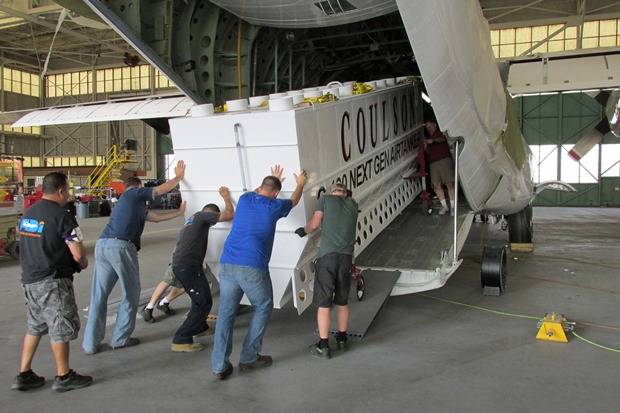
These photos show the removal of the 3,500-gallon retardant tank from Coulson’s C-130 air tanker which is being converted in San Bernardino, California. Just going by the time stamps, it took about eight minutes. The pictures were taken today and sent to us by Britt Coulson.
We attempted to contact all four of the vendors that received contracts for next-generation air tankers that are still working to convert their aircraft into air tankers. We wanted to get updates on how close they are to being ready drop retardant over fires. Minden and Coulson returned our phone calls. 10 Tanker had their two DC-10s ready to go and fully certified when the contracts were announced, so their status is obvious.
As you may know, the USFS announced on May 6 that exclusive use contracts were going to be awarded for seven next generation air tankers. The activation of the contracts was held up by a protest from Neptune Aviation, but the awards finally went to.
Only one of the five companies had their air tanker fully certified and ready to go when the awards were announced — 10 Tanker Air Carrier and their DC-10. They put Tanker 910 to work around June 1. In fact, their second DC-10, Tanker 911, was activated on a Call When Needed (CWN) contract June 14 and both of them have been flying fires since then. The two DC-10s, which always carry 11,600 gallons, dropped approximately 698,000 gallons of retardant in the month of June.
The other four companies are finishing the tank installations and still have to obtain a Supplemental Type Certificate (STC) from the FAA and have to pass a static test, dropping while parked on the tarmac; then, finally a grid test during which they drop actual retardant from the air into a grid of hundreds of cups on the ground which will determine the volume and consistency of the drop pattern. As far as I know none of the four remaining companies have scheduled a grid test yet with the Interagency AirTanker Board, which must certify all air tankers under contract with the federal government.
Minden Air Corporation
We talked with Len Parker, the CEO of Minden, who told us that they are making good progress on their BAe-146, Tanker 46, and that they expect to make the deadline for full certification, which is in the first part of August. Their tank design is very different from Neptune’s design for their BAe-146 which uses cabin air pressure to assist in forcing the retardant out of the tank. Mr. Parker told us their tank totally relies on gravity, having more than 10 feet of vertical head pressure. When asked if the door system was constant flow, he said yes and no, explaining that it is more advanced than a typical constant flow system, and uses advanced technology.
The tank holds about 3,100 gallons, he said, and when empty weighs about 2,000 pounds less than other tanks that may be used on BAe-146s, meaning they would not have to carry reduced loads of retardant as often when density altitude is an issue on hot days at high altitude.
Tanker 46 has passed the static test and meets the required flow rates, Mr. Parker told us. They are still working on the STC, but expect to select a date for the grid test by July 12.
Minden has purchased a second BAe-146 and has already started converting it.
Coulson Aircrane (USA), Inc.
Britt Coulson sent us these photos that were taken June 28, 2013. He told us the aircraft, which holds 3,500 gallons, has been painted and they will apply the wrap, which we ran a photo of earlier, later this month. He said on July 2:
…most of the tank is now installed, gear and all flight controls are checked, tank doors are going on this week, hydraulics are being finished this week as is the floor to complete the tank install.
As you can see in the photo, there are wheels attached to the tank. Mr. Coulson told us they can remove or reinstall the tank in about 30 minutes.
They still have to obtain the STC and the other certifications.
The other two companies
We called and left messages at Aero Flite and Aero Air, but the calls and emails were not returned.
Aero Flite photos?
We received the two following photos from someone who told us that they show Aero Flite’s RJ85 (Tanker 160) external retardant tank being attached to the belly and sides of an aircraft last week. We can’t independently verify they are genuine, so for now we’ll just call them an artist’s conception of what their RJ85 may look like.
The image above is a screen capture from a video of a C-130 Modular Airborne FireFighting System (MAFFS) air tanker dropping on the Papoose Fire in Colorado this week. The drop was mostly complete at this moment — the shadow of the aircraft and the retardant is surreal. I wonder if it threw off or confused the pilots.